Do faceless YouTube channels make money?
You've seen the « faceless channel, big money » videos. Here's the honest answer: the money streams, the view math, and what YouTube stopped paying for.
 Ben, founder of Montage · · 9 min read
In this post9 parts
- The short answer
- How do faceless YouTube channels make money?
- What each stream needs on screen
- What YouTube stopped paying for
- How many views does it take?
- What real faceless channels say they make
- Where Montage fits, and where it doesn't
- Questions about whether faceless YouTube channels make money
- See it in real videos
The short answer.
Let's start with the answer, because that's what you came for.
Do faceless YouTube channels make money? Yes, some do. Most don't. And what decides it isn't the missing face. It's the niche, the number of views, and whether YouTube sees your videos as yours.
Here's the thing: « faceless » isn't a business model. It's a way of making videos. The site faceless.my, one of the few pages that does the math, says it plainly: faceless is a production style, and the niche decides the economics. The money comes from the same places as any channel: ads, sponsors, affiliate links, your own products.
The niche decides the money. The face doesn't.
So in this article: where the money comes from, how many views it takes, what YouTube's rules say since July 2025, and what a video that earns has on screen when you're not on it. If you want the making part first, start with how to make faceless videos. And if you want to see the parts I'll show you in a real video, they come from a 9:18 YouTube film.
How do faceless YouTube channels make money?
Four ways. Pretty much every channel, faceless or not, earns from some mix of these.
| Stream | Where the money comes from | When it starts |
|---|---|---|
| Ads (AdSense) | Your share of the ads on your videos, plus memberships, Premium, Super Chat | Only after you join the YouTube Partner Program |
| Sponsors | A brand pays you to talk about it in a video | When a brand thinks your audience is worth it |
| Affiliate links | A commission when someone buys through your link | From your first video |
| Your own products | A course, a template, a service, your app | From your first video |
subscribr.ai puts it well: ad money is a floor, not the business. The channels that earn the most stack the other three on top of it.
Now, here's what none of the pages ranking for this question show you. Each of those streams needs something on screen. And when there's no face, you have to build that something.
What each stream needs on screen.
Let me show you, with parts from real videos. One thing first, to be exact: these videos have me in them, and I'm not telling you what they earned. The point is the parts. They work the same with no face at all.
A sponsor needs a slot that isn't your face
On a normal channel, the creator looks into the camera and reads the sponsor. No face? Then the sponsor needs its own place on screen while your voice reads it.
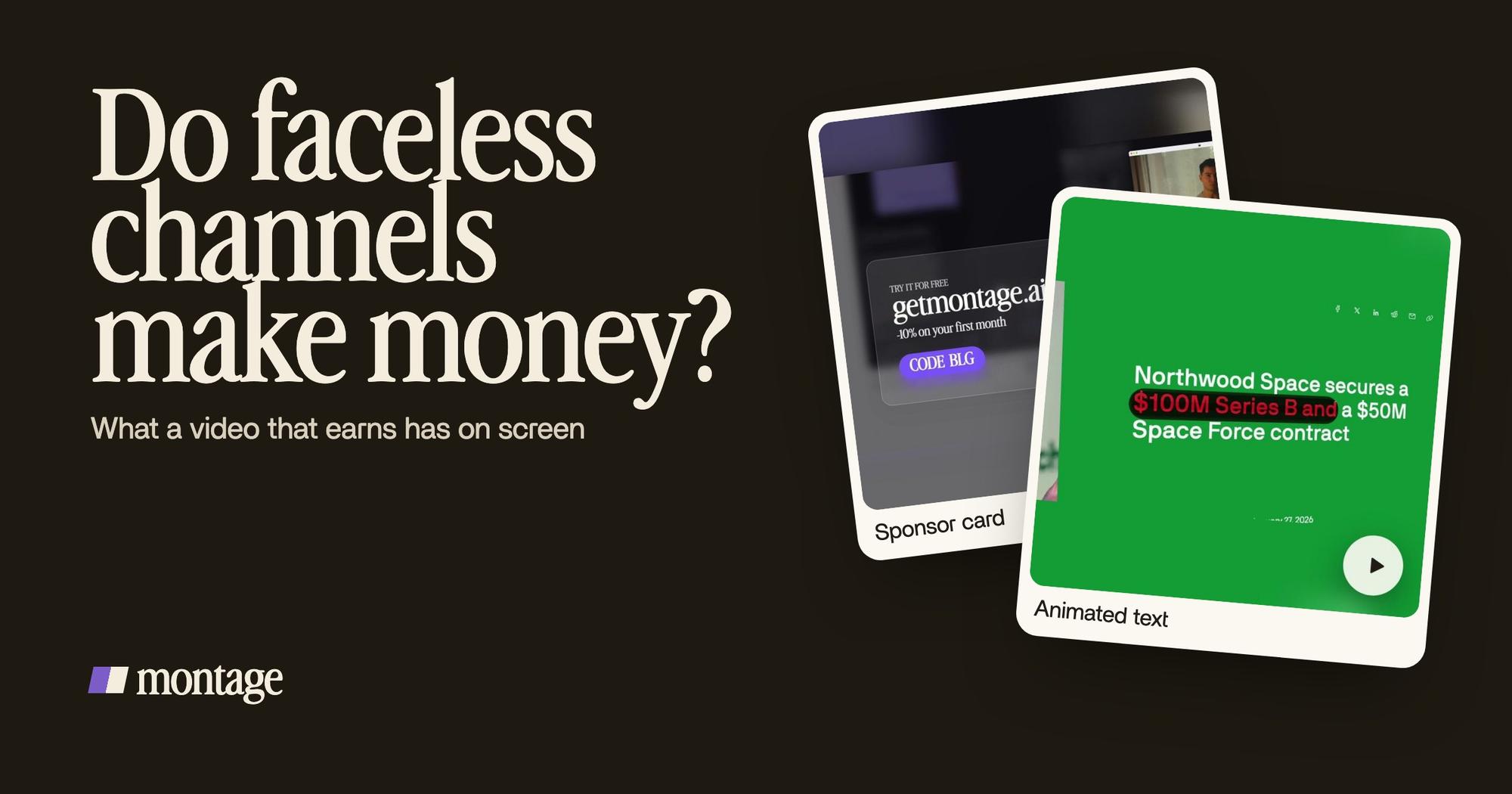
 Sponsor cardA component made for the sponsor: frosted glass, the QR code and the code BLG. Click to watch it.
 B-rollThe site drops in on a white stage while I say « go to this app called Montage ».
In From Disney star to space CEO, the sponsor gets a component made for it: frosted glass, the QR code and the code BLG. It's on screen while the read plays. That's a sponsor card you make once and reuse in every video that carries a sponsor.

An affiliate link needs the product on screen
Same idea. If you say « go check out this tool » and the screen shows stock footage of a laptop, the viewer never sees what you're talking about.
In Edit it all with AI, the site drops in on a white stage the moment I say « go to this app called Montage ». That's the product on screen the moment you name it. For an affiliate link, that's the whole job.
Ad money needs YouTube to call it original
This is the one the hype videos skip. Let me explain.
What YouTube stopped paying for.
On July 15, 2025, YouTube renamed its « repetitious content » policy to « inauthentic content »: content that is repetitive or mass-produced. YouTube says that kind of content has « always been ineligible for monetization ». The rules on reused content (clips, compilations, reactions with no commentary of yours) stayed the same. (Source: YouTube's channel monetization policies, support.google.com/youtube/answer/1311392.)
Now, read that again and think of the classic faceless channel the hype videos sell: an AI voice, stock footage, a script from a prompt, videos by the dozen. That's pretty much the description in the policy.
Honestly, a channel with nothing of yours in it is the one YouTube stops paying.
So what makes a voice-over video yours? In my opinion: your sources on screen. Your research, shown as you read it.
 Motion designA real headline, highlighted in yellow while I read it. Click to watch it.
 Animated textThe article tilts in and a red marker underlines the number. Click to watch it.
 Reusable componentsOne media card, used 26 times: a picture or a clip, its caption, on the dark page. Click to watch it.
In From Disney star to space CEO, a real headline is highlighted in yellow while I read it. An article tilts in and a red marker underlines the number. And one media card, a picture or a clip with its caption on the dark page, is used 26 times: a look the channel keeps, not a template copied with small changes. That's research you can see. The opposite of « repetitive or mass-produced ». More on headlines highlighted as you read them.
How many views does it take?
Okay. Now the math. Every « how much » question comes back to one number: the RPM.
YouTube defines RPM as your revenue per 1,000 video views, counting ads, memberships, YouTube Premium, Super Chat and Super Stickers. (Source: support.google.com/youtube/answer/9314357.) So the formula is simple:
Monthly views ÷ 1,000 × RPM = monthly ad revenue.
What RPM should you expect? Nobody can tell you until your own dashboard shows it. Here are the estimates out there:
- About $2 to $3 per 1,000 views: a Quora answer on faceless channels (Google snippet).
- $2 to $6 for gaming, $10 to $25 for finance: faceless.my's ranges by niche (May 2026), which the site itself calls planning math, not YouTube data.
Let's put three of those RPMs against the three numbers people ask about. This is arithmetic on those estimates, not data:
| Ad revenue a month | At a $2 RPM | At a $6 RPM | At a $25 RPM |
|---|---|---|---|
| $1,000 | 500,000 views | about 167,000 views | 40,000 views |
| $3,000 | 1.5 million views | 500,000 views | 120,000 views |
| $10,000 | 5 million views | about 1.67 million views | 400,000 views |
Do you see the difference? The same $1,000 is 40,000 views in one niche and half a million in another. That's what « the niche decides the money » means.
And one more thing, the part the hype skips: before you join the YouTube Partner Program, ads pay you $0. To join, YouTube asks for 1,000 subscribers with 4,000 qualified watch hours in the last 12 months, or 1,000 subscribers with 10 million qualified Shorts views in the last 90 days. YouTube also says it is updating the Partner Program from February 1, 2027, with new terms to accept by January 31, 2027. (Source: support.google.com/youtube/answer/72851.) Check that page before you plan around the numbers.
What real faceless channels say they make.
Sure, faceless channels do earn. Here's what's out there, with where it comes from:
- A Medium author running a faceless channel with AI-generated voice-overs and stock footage says they cleared « $3,200 in combined revenue »: AdSense, affiliate commissions and one small sponsorship (Google snippet; the page was blocked).
- faceless.my's ranges (May 2026): $100 to $500 a month for a small channel, $2,000 to $15,000 for a strong niche, $25,000 and up at the top, and $0 for the first months. Their estimates, not YouTube's.
- A Facebook post repeats that Devon Canup claims $1.5 million from faceless channels. A claim, not a statement I could check.
- On YouTube, one creator's video says it best: their faceless channel got monetized, and they're « not seeing huge amounts of money rolling in ».
Let's be clear: the big numbers are the exceptions that make the videos. On Reddit's r/NewTubers, people starting out still ask whether it's worth it at all.
Where Montage fits, and where it doesn't.
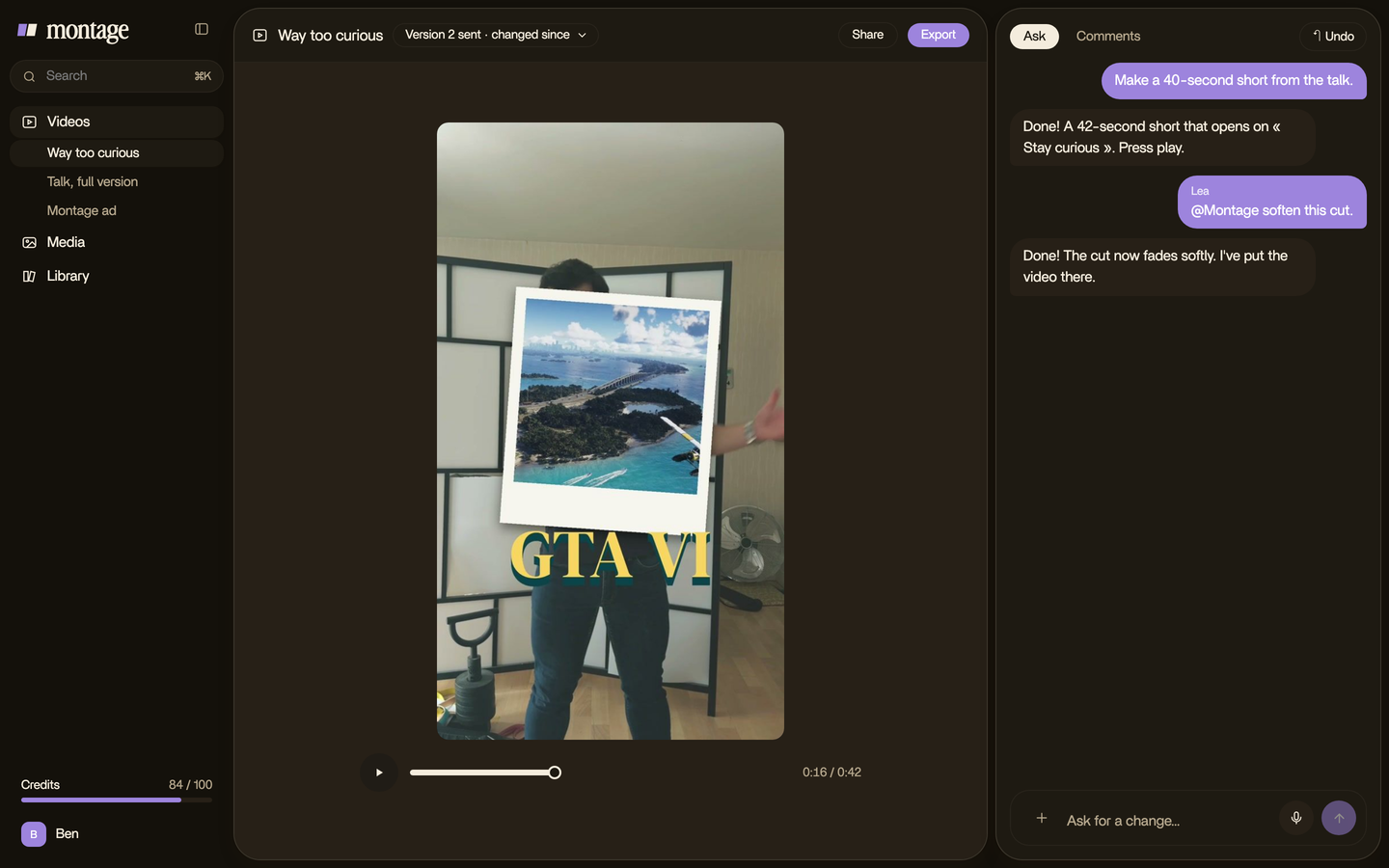
Truth is, I'd rather say this plainly. Montage edits what you give it: your voice recording, your clips, your pictures, your screen recordings. You say what you want, it makes the edit, you comment on what's wrong.
It doesn't write your script. It doesn't make a voice, an avatar or footage from nothing. It doesn't import from a YouTube link or post to YouTube. And it can't make a channel earn. Nobody can promise you that.
So if you want a channel that runs itself, Montage isn't for you. If you want a faceless channel with your voice, your research and a look you keep, that's exactly what it edits. More on starting a faceless YouTube channel, and faceless ideas sorted by what you can record.
Questions about whether faceless YouTube channels make money.
Do faceless YouTube channels make money?
Yes, some do. They earn from ads (after joining the YouTube Partner Program), sponsors, affiliate links and their own
products, like any channel. How much depends on the niche and the views, not on the face. Many earn little or nothing.
How much can you earn from a faceless YouTube channel?
Anywhere from $0 to a lot. faceless.my estimates $100 to $500 a month for a small channel and $2,000 to $15,000 in a strong
niche (May 2026, their estimates). Your own RPM, in your dashboard, is the only number that counts.
How many YouTube views do you need to make $1000?
Divide $1,000 by your RPM, then multiply by 1,000. At a $2 RPM that's 500,000 views; at $6, about 167,000; at $25, 40,000.
Arithmetic on estimated RPMs, not data.
How many YouTube views do I need to make $3,000 per month?
From ads alone: 1.5 million views a month at a $2 RPM, 500,000 at $6, 120,000 at $25. Sponsors and affiliate links can make
that number much smaller.
How many views do I need to make $10,000 a month on YouTube?
From ads alone: 5 million views a month at a $2 RPM, about 1.67 million at $6, 400,000 at $25. At that level, most channels
earn a big part from sponsors and products, not ads.
Are faceless YouTube channels getting demonetized?
Not for being faceless. Since July 15, 2025, YouTube calls repetitive or mass-produced videos « inauthentic content », and
says that kind of content has always been ineligible for monetization. A faceless video with your own voice and research
is not that.
See it in real videos.
Every part in this article was asked for in a sentence, in real videos. The four videos in the showcase show what went in and how each one was made.
 9:18
 2:07
 0:56
 0:38
That's it for this one. Pick a niche, then make something of yours.
See you in the next one.