Intro hooks:
how to win the first seconds of a video.
Most guides treat a hook as a sentence. On video, it's a sentence and a picture. Here are the types that work, what each one looks like on screen, and a real hook taken apart.
 Ben, founder of Montage · · 8 min read
In this post10 parts
The short answer.
Ladies and gentlemen, let's start with the answer.
Intro hooks are the first seconds of your video: the part that decides if someone keeps watching or scrolls past. On TikTok, Reels and Shorts, that's pretty much everything. A good hook tells the viewer, right away, why this video is for them.
Here's the thing most guides miss: they treat a hook as a sentence. Something you write, or something you say. On video, that's only half of it.
A hook is something you say and something you see.
So a video hook is three things at once. What you say. What's on screen. And what moves. Get all three working on the same idea, and the first seconds do their job.
This article is part of the guide on how to edit TikTok videos. Here, we zoom in on the opening.
What makes a hook work on video?
So why isn't a good sentence enough? Let me explain.
Read the pages that rank for this search and you'll find the same idea everywhere. A writing handout from East Stroudsburg University lists four hook types for an essay: a question, a quotation, a statistic, an anecdote. Neal O'Grady, who studied viral posts on LinkedIn and X, lists ten ways to hook people and says a hook is « the first 1-3 sentences ».
Those are good lists. But they're written for the page: an essay, a post.
On a phone, people see your video before they hear it. Plenty of them have the sound off. So the line you say needs a picture that carries the same idea, and something that moves to catch the eye.
- What you say: the line. A question, a claim, a promise.
- What's on screen: the words as captions, a picture, a card.
- What moves: a zoom, a picture dropping in, a word growing bigger.
If one of the three says something else, the hook feels off. If all three say the same thing, it lands.
Intro hooks examples, by type.
Okay. Here are the types that come up again and again, with an example line for each. The line is the easy part. The right column is what most people forget.
| Hook type | What you say (example) | What's on screen |
|---|---|---|
| Question | « Why does your footage look grey? » | The question as a caption, the key word bigger |
| Bold claim | « You don't need a timeline to edit. » | The claim in big words, a quick punch-in on your face |
| Curiosity | « I tried one thing for 30 days. » | The thing itself drops in as a picture |
| Value | « Three cuts that make any video shorter. » | A number on screen, then the first cut right away |
| Identity | « If you film yourself on a phone, watch this. » | You, close, talking to the camera, captions on |
| Counter-belief | « Longer videos aren't always worse. » | The common belief on screen, then crossed out or pushed away |
| Reply to a comment | You answer what someone asked you | The comment itself, shown as a card, before you speak |
Most good hooks mix two of these. Neal O'Grady says the same about posts. A question with a picture that answers it. A bold claim with a zoom on the word that matters.
Pick one idea. Then say it, show it, and move it.
A real hook, taken apart.
Let's look at a real one.
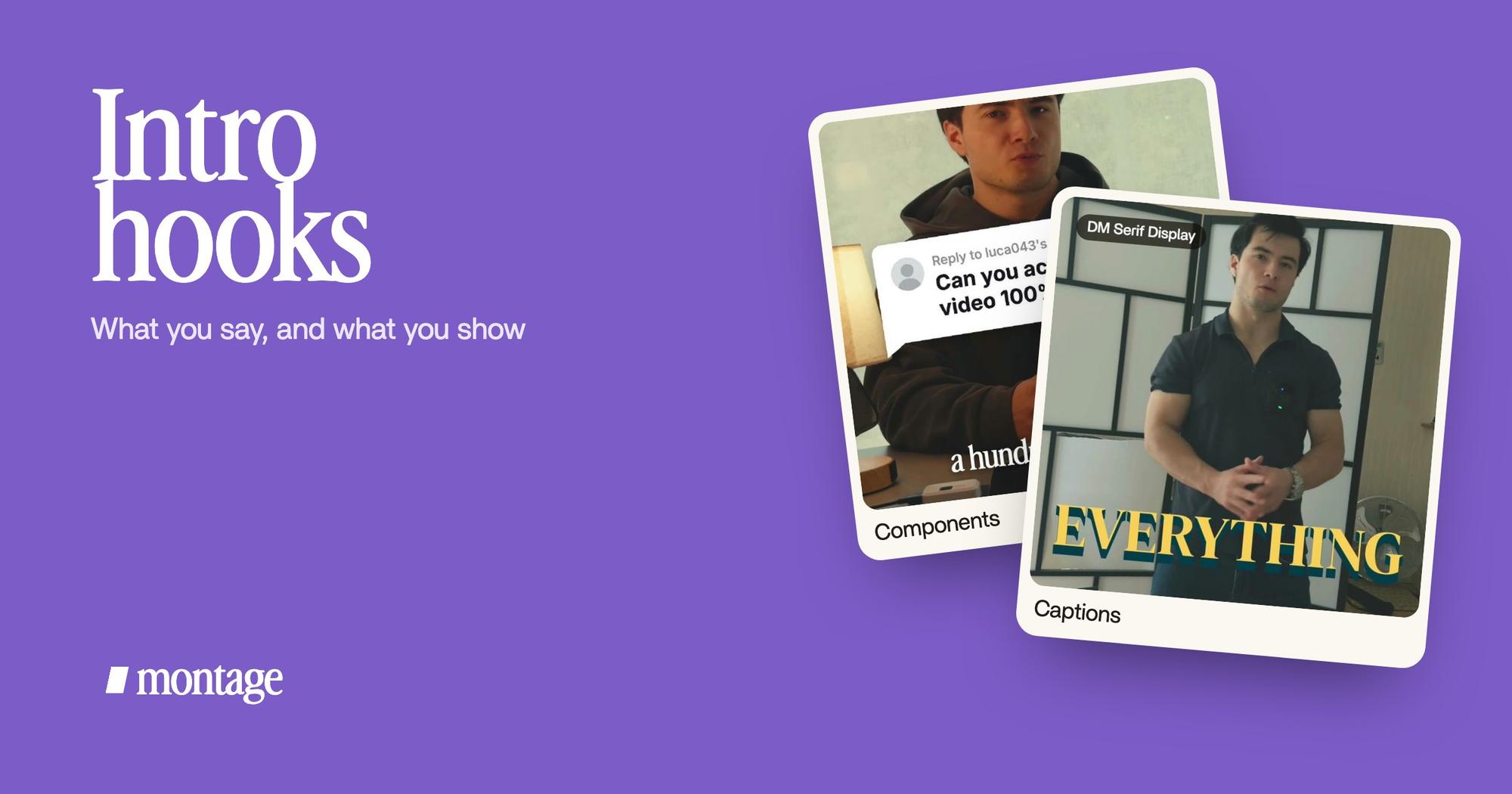
Edit it all with AI is a 38-second ad, vertical, 9:16. Its hook is a white Instagram reply. That's the « reply to a comment » type from the table: the screen shows something the viewer already knows from their own phone.
And here's the part I like. That reply isn't a one-off. It was made as a component and reused.
 ComponentsThe hook: a white Instagram reply, made as a component and reused. Click to watch it on its own.
 CaptionsOne line at a time, white on the take, dark on the white stage.
Then the captions take over: one line at a time, white on the take, dark on the white stage. Short lines, so the eye never has to catch up.
Now, Way too curious shows the other two parts. The key word is drawn bigger in the captions: yellow, uppercase, a blue drop shadow. And on « everything » and « curious », the picture pulls back on black. The words you say, the words you see and the movement all point at the same thing.
 CaptionsYellow, uppercase, a blue drop shadow, and the key word drawn bigger.
 ZoomsA slow push-in on every shot, and on « everything » and « curious » the picture pulls back on black.
Do you see the pattern? Nothing here is a trick. Each piece just says the same idea a second way.
Pictures that stop the scroll.
Sometimes the picture is the hook. You don't need a line at all for the first second, just something the thumb doesn't expect.
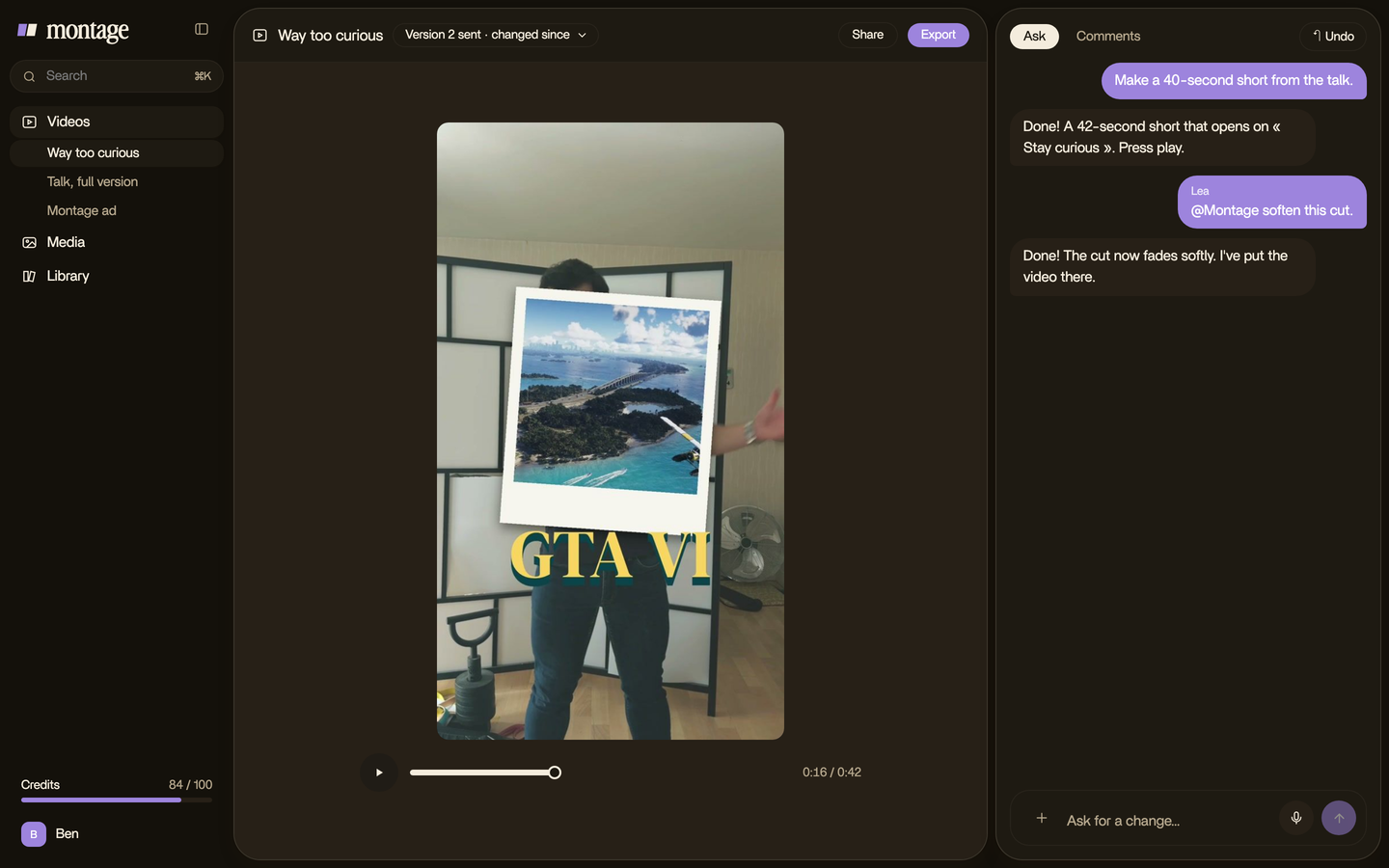
In Edit it all with AI, I'm cut out of my background and my head rises over the top of the frame. In Way too curious, the Photo drop is a component Montage made from my words: I say GTA VI, it drops in.
 Background effectCut out of my background, my head rises over the top of the frame.
 ComponentsThe Photo drop is a component Montage made from my words: I say GTA VI, it drops in.
Both work for the same reason. Something happens on screen that the viewer didn't expect.
How to make an intro hook, step by step.
Here's how I'd do it. Six steps.
- Write one line. Pick a type from the table. Say it out loud. If it takes more than a breath, cut it down.
- Film it two or three times. Different energy each time. You'll keep the best one.
- Decide what's on screen. The caption style, a picture, a card. Whatever shows the same idea as the line.
- Decide what moves. A punch-in on the key word, a picture dropping in, a word that grows.
- Ask for it. In Montage, you say it in a sentence: the line, the caption style, the zoom. Then watch the first seconds.
- Comment on the moment that's off. Pause on the exact frame and say what's wrong: « make this word bigger », « drop the picture in a beat earlier ». Then fix everything at once.
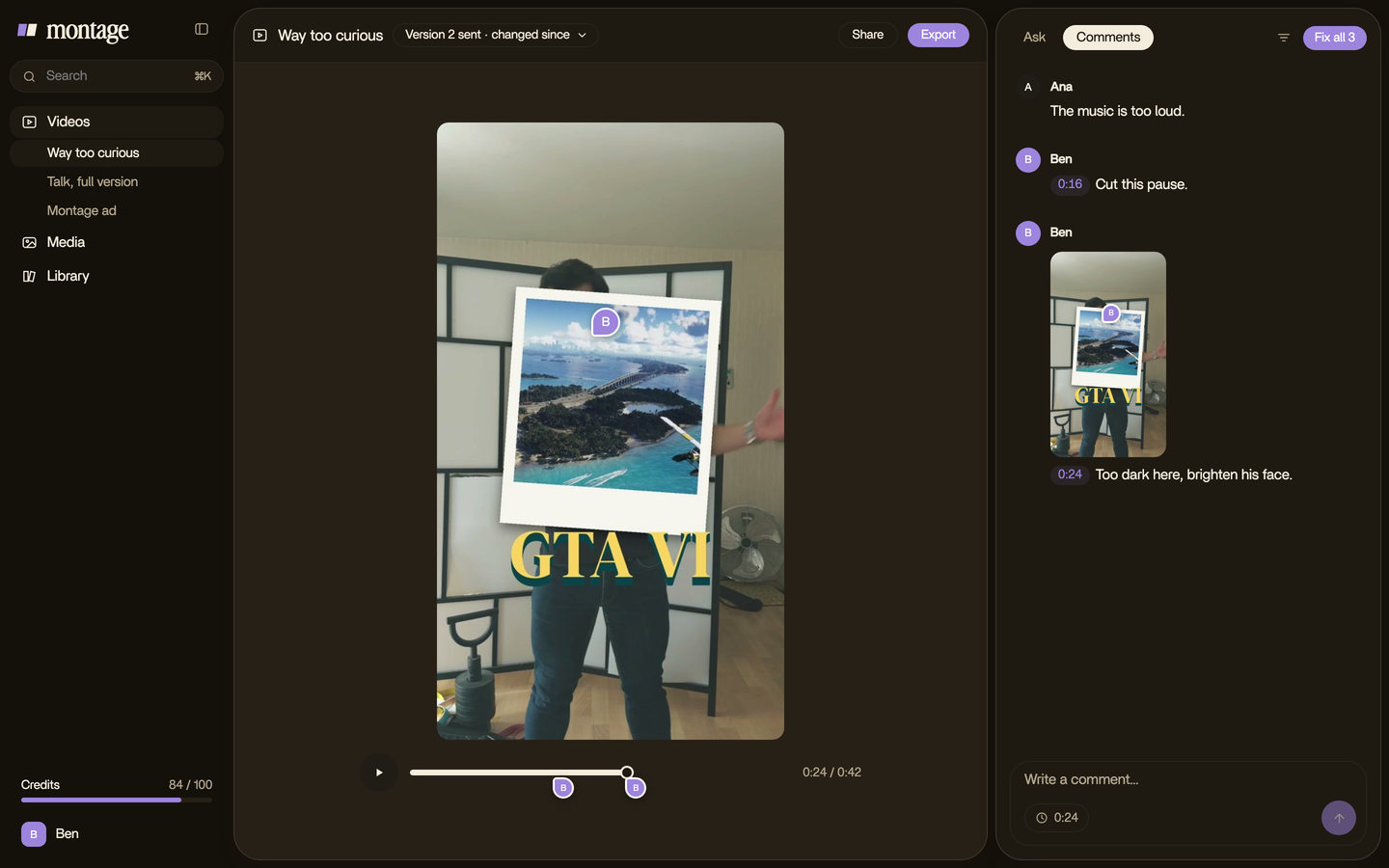
For the words, here's how captions that land word by word work in Montage.
Keep the hook that works.
Once a hook works, don't rebuild it from zero on the next video. Keep it.
That's what happened with the Instagram reply in Edit it all with AI: made once as a component, reused. The Photo drop in Way too curious is a component too. You can keep the hook as a component and drop it into the next video with new words.
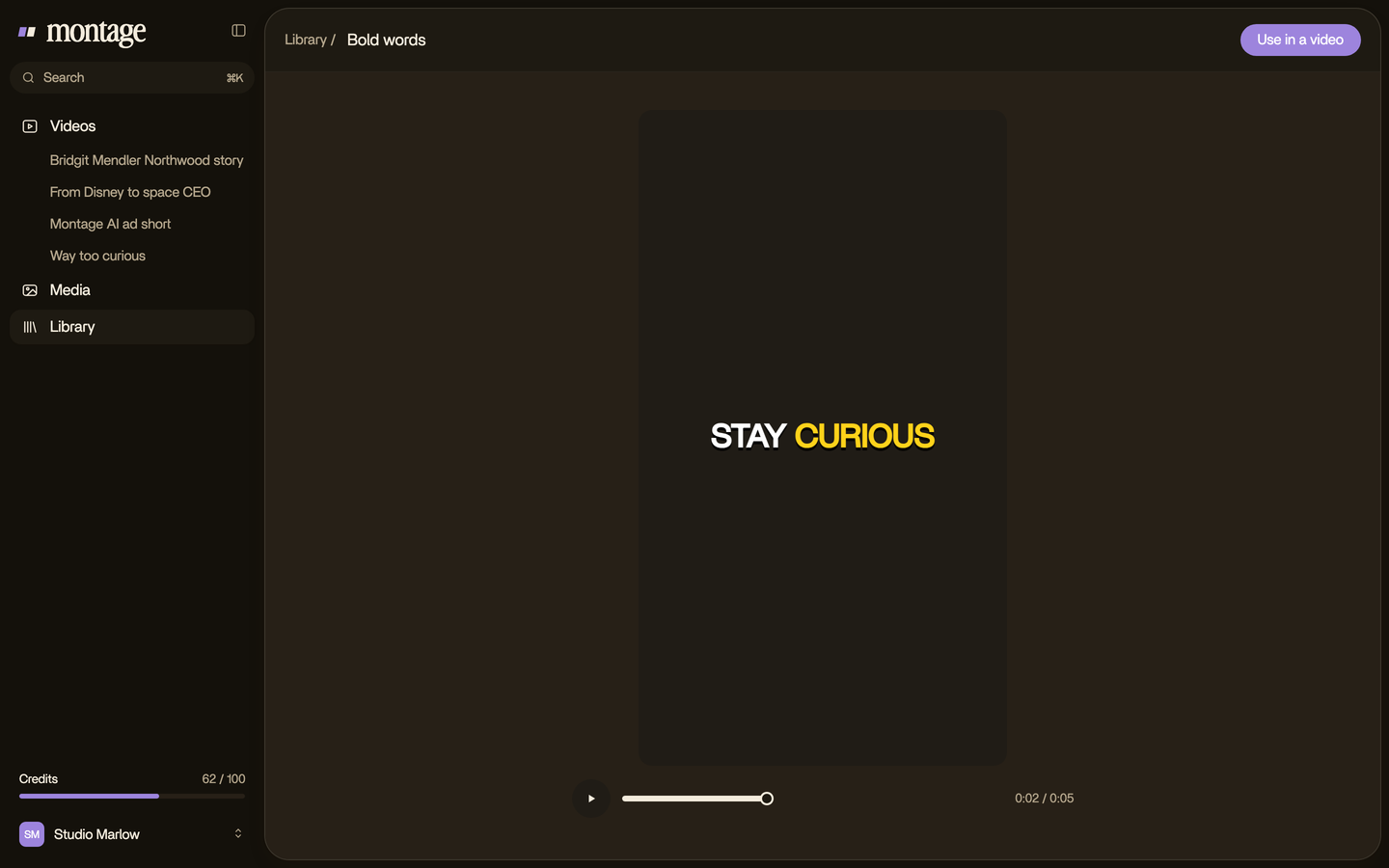
Find a hook that works once. Then use it every week.
To be honest, this is where most of the time goes when you post several times a week. Not the idea. Rebuilding the same opening again and again.
The mistakes that kill a hook.
Let's be clear: these are easy to make.
- A slow start. A logo, a « hey guys », a breath before the first word. Start on the line.
- The line and the picture don't match. You ask a question, the screen shows something else. Pick one idea.
- No captions. People scroll past a silent face. The hook has to read with the sound off.
- Too many moves. A zoom, a shake, three pictures and a sound in two seconds. One move, on the key word.
- A promise the video doesn't keep. The hook gets the view. The rest of the video has to earn the next one.
And how long should the whole thing be? That's its own question: here's how long a Reel should be, and the length of a Short.
Intro hooks: your questions.
What is a good hook for an intro?
A good intro hook tells the viewer in the first seconds why the video is for them. On video, say one clear line and show
the same idea on screen at the same time.
What are some good examples of a hook?
A question (« Why does your footage look grey? »), a bold claim, a promise of value (« three cuts that make any video
shorter »), or a reply to a comment shown on screen, like the Instagram reply that opens Edit it all with AI.
What is a good hook sentence starter?
Start with the viewer or the result: « If you… », « Why does… », « Stop… », « Here's how… ». Then get to the point in
one breath.
What is a catchy hook?
A catchy hook is one where what you say, what's on screen and what moves all point at the same idea. That's what makes
people stop.
What is a hook in an essay?
In an essay, the hook is its first sentence. This article is about videos.
See it in a real video.
Want to see the hook in context? Watch the whole 38-second ad, from the Instagram reply to the last line. And if you're starting a short from scratch, here's making a TikTok from start to finish, and what short-form video is if you're new to it.
 9:18
 2:07
 0:56
 0:38
That's it for this one. Now go film your first three seconds.
See you in the next one.