Cutaway shot:
what it is, with real examples.
A cutaway shot leaves the main action for a moment, shows something else, and comes back. Let me show you what that means in a video of you talking, with two real ones.
 Ben, founder of Montage · · 8 min read
In this post9 parts
- The short answer
- What a cutaway shot is for
- Why a creator needs cutaways more than a film does
- What a cutaway looks like in a talking-head video
- Cutaway vs insert shot vs cut-in
- One cutaway, used 26 times
- How to edit a cutaway shot into a talking-head video
- Cutaway shot: your questions
- See it in real videos
The short answer.
Ladies and gentlemen, let's start with the answer, because that's what you came for.
A cutaway shot is a shot that interrupts the main action to show something else, then cuts back to it. That's the definition Wikipedia gives: a view of something else, inserted into a continuously filmed action, usually followed by a cut back to the first shot.
In a film, that something else can be a memory, a clock on the wall, another place entirely. In a video of you talking to the camera, it's simpler. You name a thing, and the picture shows it. Most of the time, that cutaway is B-roll footage: the extra shots that play while you keep talking.
Say it, show it, come back.
That's it. Now let me show you why it matters so much more when you film yourself.
What a cutaway shot is for.
So what does a cutaway actually do? Let me explain, with the film people's words first.
Wikipedia lists three jobs:
- Adjust the pace. A cutaway breaks a long shot so it doesn't drag.
- Hide a cut. It conceals the deletion of an unwanted part of the main shot.
- Join two versions of a shot. You leave one take on the cutaway and come back on another.
In news and documentaries there's a classic one. One camera films the person being interviewed. Afterwards, the interviewer's questions and nods are filmed again, and the editor cuts to them to cover the cuts in the answer. Those nods even have a name: « noddies » (Wikipedia).
Films use cutaways for a lot more. StudioBinder walks through memories, daydreams, feelings, another time, and tension kept in the same place, as in The Godfather. Filmsupply adds war films like Saving Private Ryan.
Sure. But here's the thing every one of those pages misses: they're about cinema, a crew, a second camera. Not one of them shows a cutaway in a video one person filmed alone.
Why a creator needs cutaways more than a film does.
One of the cutaway's jobs, in Wikipedia's list, is to hide a cut. In a video of you talking, that's pretty much the whole edit.
Let me give you a real one. My film From Disney star to space CEO started as seven takes, 33 minutes filmed on an iPhone. The finished film is 9 minutes and 18 seconds, with 216 cuts. Every pause taken out, every retake dropped, is a jump cut. A cutaway is how some of them disappear: the picture leaves your face, and when it comes back, nobody saw the jump.
And there's no interviewer to film noddies of. So what do you cut away to? In my opinion, the answer is in your own words.
In a film, a cutaway is a choice. In a video of you talking, it's how your cuts disappear.
What a cutaway looks like in a talking-head video.
Here's the cue: you cut away to what you just named. You say the book, the book is on screen. You say the show, the show plays.
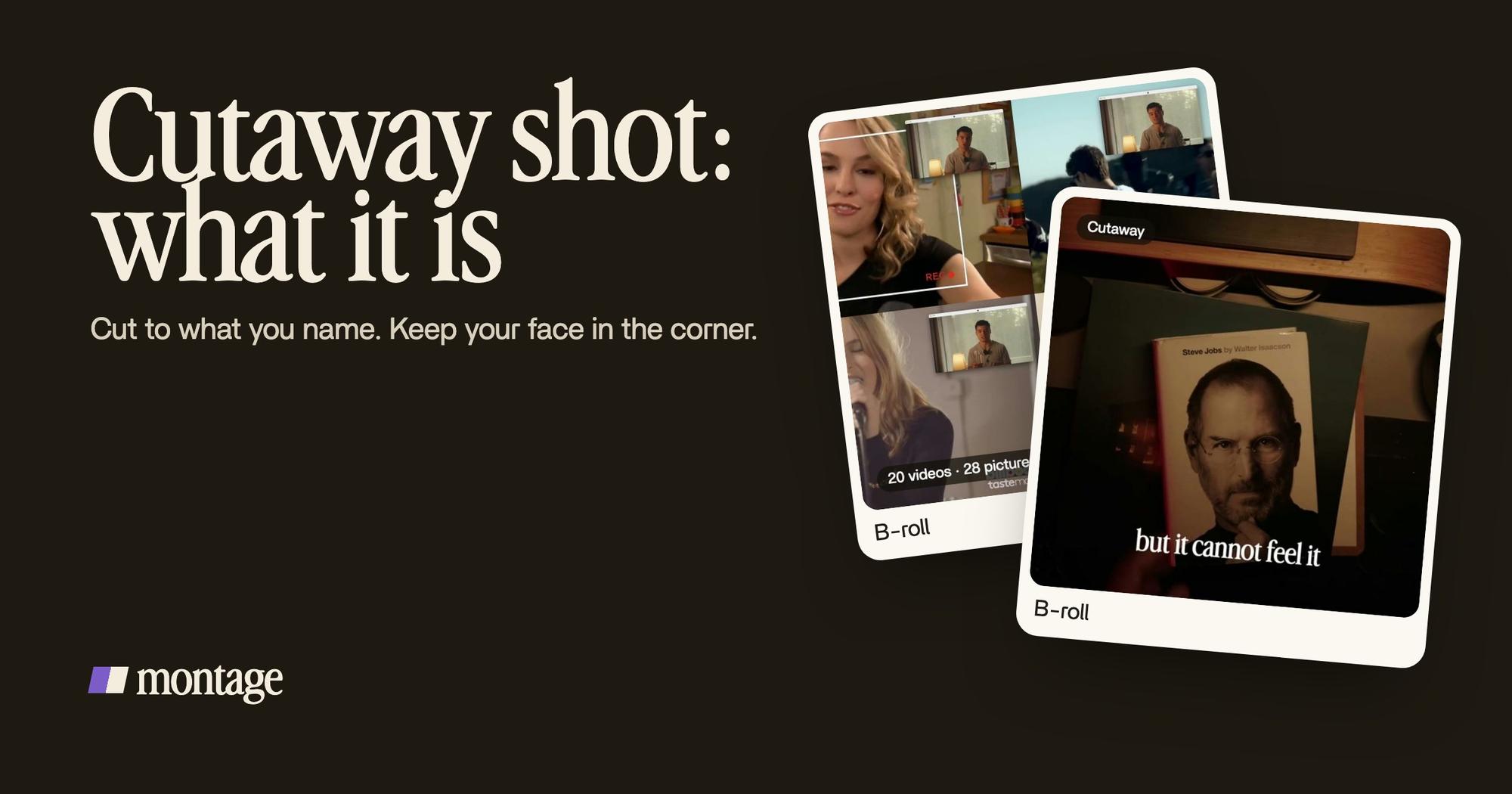
 B-rollGood Luck Charlie, Ready or Not, Billboard, the TODAY antenna: the face cam moves to the corner while each plays.
 B-rollWhile I talk, it cuts to the right shot: the book, the notebook, the whiteboard.
In From Disney star to space CEO: Good Luck Charlie, Ready or Not, Billboard, the TODAY antenna. The face cam moves to the corner while each one plays. So the viewer sees the thing, and still sees who's talking. A cutaway where the face doesn't have to leave.
In How to be creative, it's the classic version. While I talk, it cuts to the right shot: the book, the notebook, the whiteboard. Then back to me.
Do you see the pattern? The word is the cue, every time. If you're short on ideas for what to show, here are B-roll ideas for what to cut away to.
Cutaway vs insert shot vs cut-in.
Okay. This is where people get lost, so let's put them side by side.
StudioBinder and Filmsupply draw the same line between a cutaway and an insert. An insert is a close-up of something real in the same scene: a detail you could reach out and touch. A cutaway can go anywhere: another time, another place, or something that isn't real at all.
And the cut-in? Filmsupply uses it for the cut back to the main action, once the cutaway is over.
Applied to my two videos: the book, the notebook and the whiteboard in How to be creative are close shots of things in my own story, so they sit on the insert side of that line. The Good Luck Charlie and TODAY clips come from another time and another place: pure cutaways.
| What it is | An example | |
|---|---|---|
| Cutaway | Leaves the main action for something else, then comes back | A TV clip from another year, while you tell the story |
| Insert | A close-up of a detail in the same scene | The notebook you're talking about, filmed up close |
| Cut-in | The cut back to the main action after the cutaway | Back on your face, mid-sentence |
| B-roll overlay | A picture or clip laid over your take, the voice going on | Your photo dropping in when you say the word |
| Jump cut | A cut inside one shot, so the picture jumps in time | A pause taken out of your take |
The jump cut has a cousin, too: here's jump cut vs match cut.
Cutaway vs B-roll overlay
One more, because it's close. In Way too curious, I say CrossFit, and my photo drops in. That's not quite a cut away from the take. It's a picture over it.
 B-roll
Different shape, same cue: the word you say.
One cutaway, used 26 times.
Now, here's something none of the guides that rank talks about: a cutaway can be a style you set once.
 Reusable componentsOne media card, used 26 times: a picture or a clip, its caption, on the dark page. Click to watch it.
 Picture in pictureThe guest gets a window of her own: Bridgit at TechCrunch Disrupt, over a Mac desktop, while I keep talking.
In From Disney star to space CEO, there's one media card, used 26 times: a picture or a clip, its caption, on the dark page. Twenty-six cutaways, one look. That's a reusable media card, made once.
Its long-form cousin is the picture in picture: Bridgit at TechCrunch Disrupt gets a window of her own, over a Mac desktop, while I keep talking.
Decide how a cutaway looks once. Then just say where it goes.
How to edit a cutaway shot into a talking-head video.
Here's how I'd do it. Six steps.
- Film the things you'll name. After your takes, five minutes on the book, the screen, the place. Or gather the clips and pictures you'll mention.
- Drop everything in. The takes and the clips you'll cut away to, as they are.
- Cut the pauses and the retakes first. That's where the jump cuts come from. Here's how cutting the pauses and retakes works.
- Say where the cutaways go. The cue is the word: each cutaway starts when you name the thing.
- Keep the sound going. Your voice carries over the cutaway, so it never feels like a break. Filmsupply makes the same point about sound carrying over the cutaway.
- Watch it, and fix the one that lands late. A cutaway that arrives a second after the word feels off. Point at it.
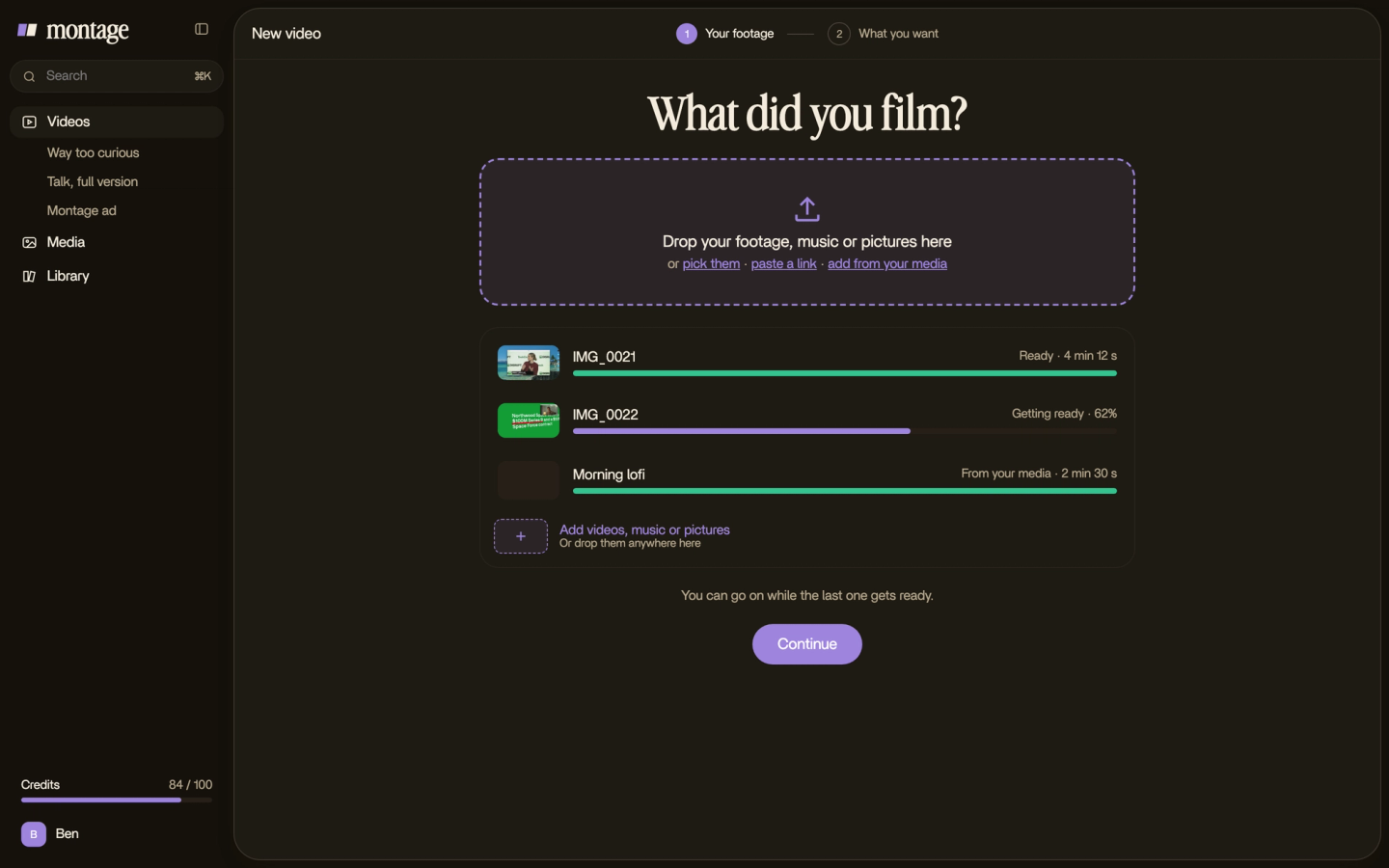
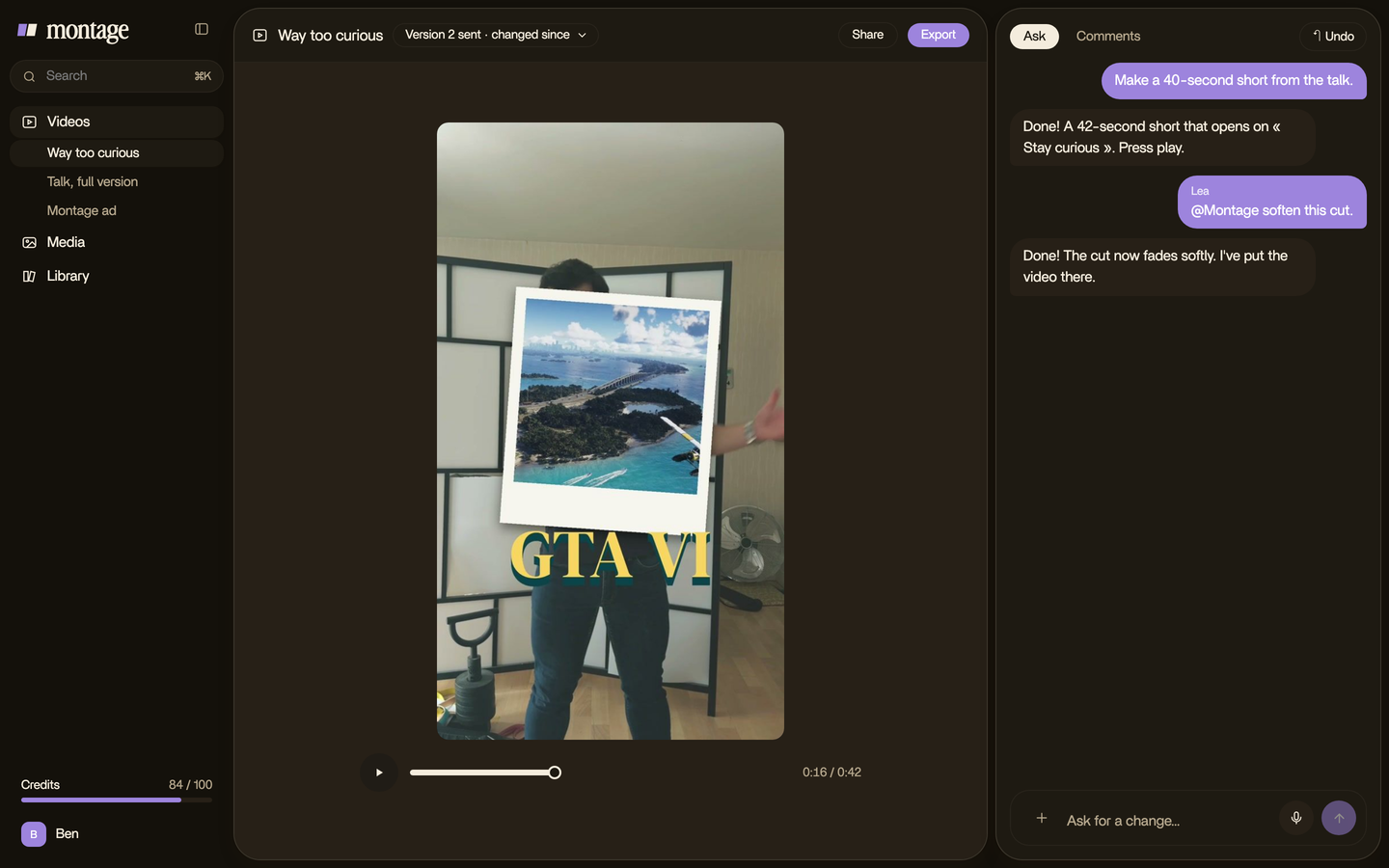
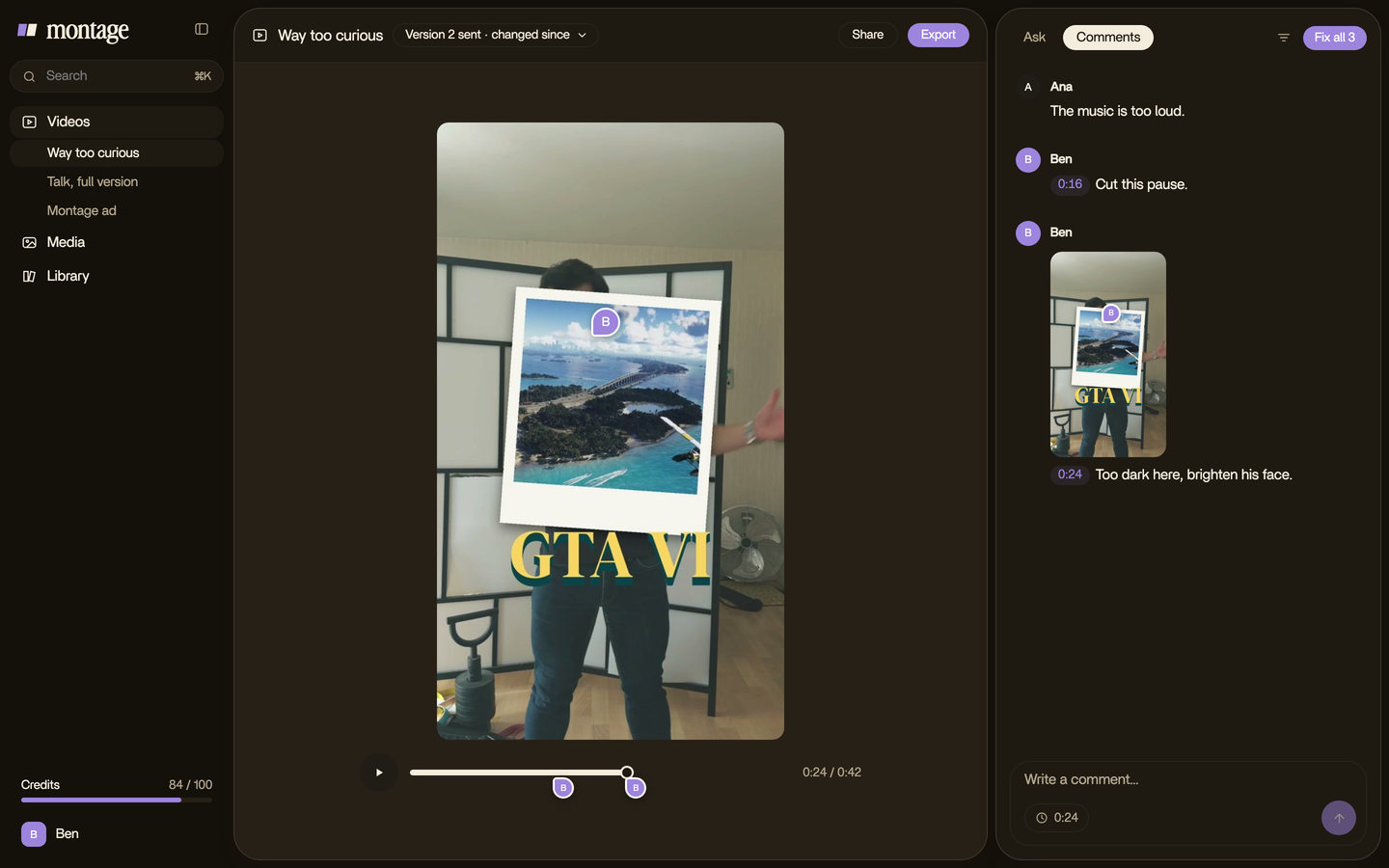
In Montage, steps 3 to 6 are sentences, not clicks. That's how B-roll gets placed on the word.
Let's be clear about one thing, though. Stock footage is a fine source of cutaways: Filmsupply sells it, and Pexels and Pixabay are free. Montage doesn't search for stock clips or make them up. It places the ones you give it.
Cutaway shot: your questions.
What is a cutaway shot?
A cutaway shot interrupts the main action to show something else, then cuts back. In a video of you talking, it's
usually the thing you just named, shown while your voice keeps going.
Can you give me an example of a cutaway shot?
In From Disney star to space CEO, clips of Good Luck Charlie, Billboard and the TODAY antenna play while my face cam
moves to the corner. In How to be
creative, the picture cuts to the book, the notebook and the whiteboard while I talk. You can watch the long film with
the face cam in the corner.
What is the difference between a cutaway and an insert shot?
An insert is a close-up of a detail in the same scene. A cutaway can go to another time, another place, or something
that isn't real (StudioBinder, Filmsupply).
What's a Family Guy cutaway?
Family Guy is known for cutaway gags: a quick jump to an unrelated scene, then back. Wikipedia notes that The Simpsons
stopped doing them because of Family Guy.
Is a cutaway the same as B-roll?
Not quite. B-roll is the footage; a cutaway is the cut to it and back. In a talking-head
video, most cutaways are B-roll. More on filming yourself with
cutaways in mind.
See it in real videos.
My cutaways in this guide all come from the real videos below, each one asked for in a sentence. Watch them, and notice when the picture leaves the face.
 9:18
 2:07
 0:56
 0:38
That's it for this one. Now go film the things you talk about.
See you in the next one.