Smash cut vs jump cut:
what's the difference?
One cut jolts you into another scene. The other skips ahead so quietly you barely see it. Here's the difference, the famous examples, and which one a video of you talking needs.
 Ben, founder of Montage · · 8 min read
In this post10 parts
- The short answer
- Smash cut vs jump cut, side by side
- What a jump cut is
- What a smash cut is
- How to tell them apart: two questions
- Not every cut to another picture is a smash cut
- Which one your video needs
- How the jump cuts get made without a timeline
- Smash cut vs jump cut: your questions
- See it in real videos
The short answer.
Let's start with the answer.
Smash cut vs jump cut comes down to where the cut takes you. A jump cut stays in the same shot and skips ahead in time: a pause gone, a retake gone. A smash cut leaves the scene, suddenly, at a moment you don't expect, and jolts you with the contrast between the two sides.
A jump cut stays in the shot. A smash cut leaves the scene.
If you want the jump cut on its own, where it came from and how to make a clean one, here's the jump cut, in full. And if it's the match cut you're mixing them up with, here's how a match cut differs.
So how do the two compare? Let me show you.
Smash cut vs jump cut, side by side.
Okay. The two cuts, plus the one people confuse with a smash cut.
| Jump cut | Smash cut | Cutaway (B-roll) | |
|---|---|---|---|
| What it does | Takes a piece out of one shot, so time skips forward | Cuts abruptly to a very different scene | Shows another picture while you keep talking |
| Same shot or a new one? | Same shot | A new scene | A new picture, same moment |
| Does the viewer notice? | Barely, when it's clean | Yes, that's the point | Not as a cut |
| Why you use it | Pace: no pauses, no retakes | Surprise: a joke, a scare, a reveal | To show what you're talking about |
| How often in a video | Every few seconds | Once or twice | Often |
| Planned when | In the edit | Usually in the script | In the edit, or when you film the B-roll |
| A film example | Godard's Breathless (1960) | Shaun of the Dead (2004), the Gilligan cut | Any documentary |
| A creator example | 216 of them in a 9-minute YouTube film | The punchline after a big promise | « I say CrossFit, my photo drops in » |
And the match cut, in one line: a match cut makes the change feel smooth, a smash cut makes it feel sudden.
What a jump cut is.
Short version, because it has its own article. A jump cut cuts between two moments of the same shot. Your head is in the same place, the room is the same, and a few seconds are gone. Videomaker describes it as cutting between very similar shots inside the same scene.
Why do people use jump cuts? To take out the pauses and the stumbles, and keep the pace. In a video of you talking, it's most of the edit.
Let me give you a real number. My film From Disney star to space CEO started as seven takes, 33 minutes filmed on an iPhone. The finished film is 9 minutes and 18 seconds, with 216 cuts: the pauses and the retakes taken out, the best take of each line kept.
 Components
My face cam sits in the same window on every one of those cuts. Nobody watching counts them. That's the job.
What a smash cut is.
Now the other one. Wikipedia defines a smash cut as an abrupt cut, at a moment where you wouldn't expect one, for a comic, narrative or emotional effect. What makes it a smash cut is the difference between the two sides: frenzied to calm, pleasant to tense.
The classic one? Someone screaming in a nightmare, then a smash cut to them waking up in bed. Wikipedia also gives a knife raised over a victim, then a smash cut to the knife coming down on vegetables.
Videomaker's examples are mostly about comedy and timing:
- The joke. Shaun of the Dead (2004) uses smash cuts for laughs.
- The Gilligan cut. A character swears something will happen, then the cut shows the opposite. In Indiana Jones and the Last Crusade (1989), Brody « will blend in », and the next shot has him lost in a bazaar. Wikipedia says the name comes from Gilligan's Island, and the UK calls it a « bicycle cut ».
- The jump in time. One scene ends, the next one lands years later, with no transition to warn you.
Videomaker adds two things I think matter. A sudden sound, or complete silence, makes a smash cut hit harder. And use it sparingly: the more you do it, the less it works.
In a script, by the way, it's written « SMASH CUT TO: », where a plain cut is « CUT TO: ».
How to tell them apart: two questions.
So how do you know which one you're looking at in your own edit? Two questions.
- Is it the same shot on both sides? Same framing, same place, a few seconds missing. That's a jump cut.
- Is it a different scene, at a moment you didn't expect, with a change in tone? That's a smash cut.
And if the answer to both is no? A different picture, the same tone, and your voice going on over it. That's not a smash cut. Which brings me to the mix-up.
Not every cut to another picture is a smash cut.
Here's the thing: a lot of people call any cut to a different picture a smash cut. It isn't.
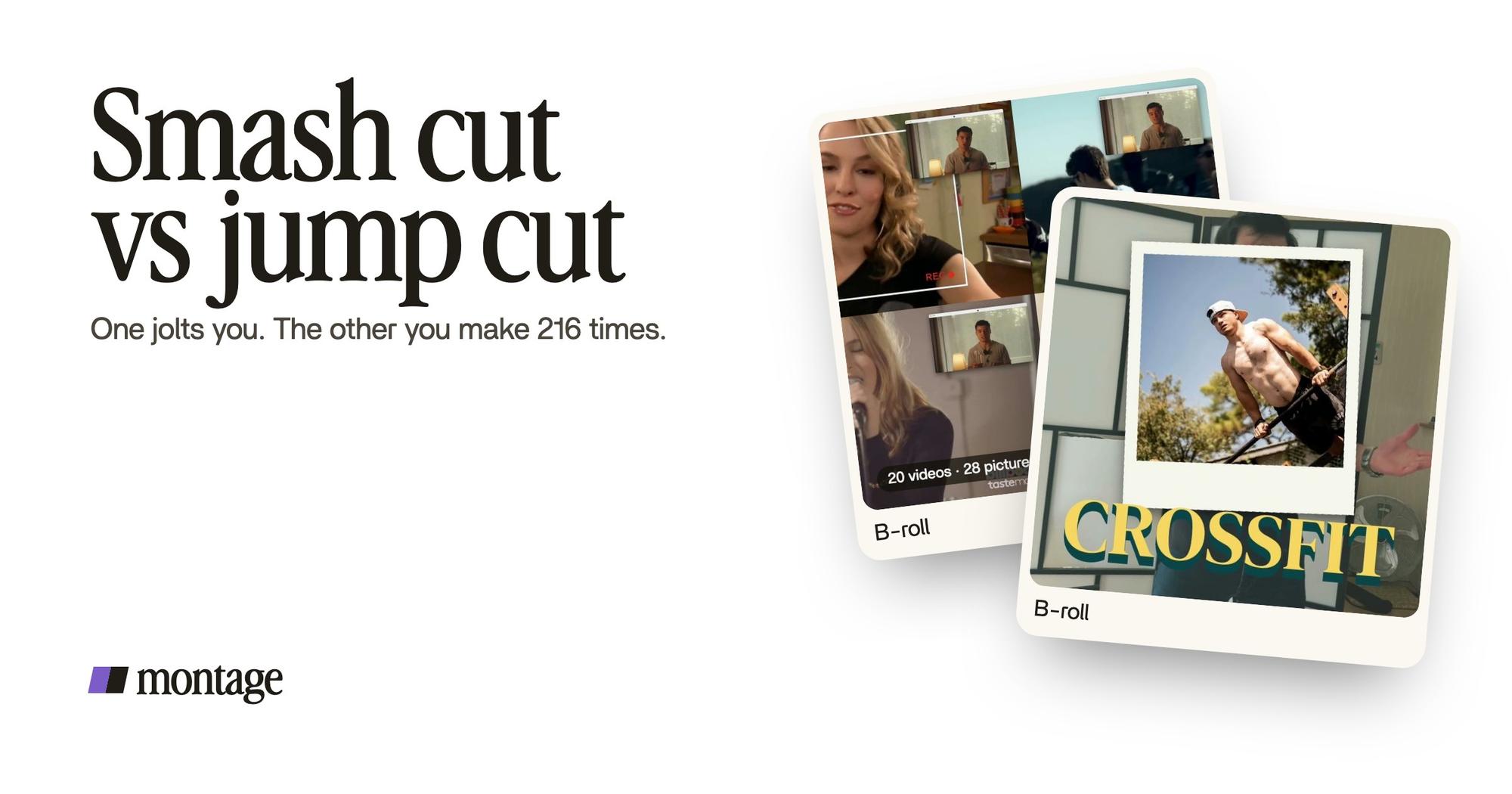
In From Disney star to space CEO, Good Luck Charlie, Ready or Not, Billboard and the TODAY antenna play while my face cam moves to the corner. In Way too curious, I say CrossFit, and my photo drops in.
 B-rollGood Luck Charlie, Ready or Not, Billboard, the TODAY antenna: the face cam moves to the corner while each plays.
 B-rollI say CrossFit, my photo drops in. One picture for each thing I love.
Both cut to another picture. Neither is a smash cut. The talk carries on, the tone doesn't flip, nobody is surprised. That's B-roll: a cutaway that shows what you're saying. More in the guide to B-roll footage, and here's what a cutaway shot is. In Montage, it's B-roll dropped in on the word.
A cut to another picture under your voice is B-roll. It becomes a smash cut when the surprise is the point.
What a smash cut does share with good B-roll is timing. In Way too curious, on « everything » and « curious », the picture pulls back on black.
 Zooms
That's a zoom, not a smash cut. But it shows the beat a smash cut needs: the change lands exactly on a word. Here's a pull-back on one word, the way Montage does it.
Which one your video needs.
In my opinion? For a video of you talking to the camera, you need jump cuts every few seconds. That's what editing a talking-head video is, most of the time.
A smash cut is a punchline. One or two in a video, at most. Plan it: the big promise, then the cut to reality. The calm intro, then the chaos. Put it on a word, add a sound or cut to silence, and don't do it again five seconds later.
Sure. But if you're a film student or writing a script? The film view is right on its own terms: a smash cut is for shock, for comedy, for a jump in time, and it's written into the script before anyone films.
You make jump cuts by the hundred. A smash cut, you make once.
How the jump cuts get made without a timeline.
In a timeline editor, you find every cut point by hand. In Montage, you cut the pauses and the retakes by saying it: « cut the pauses and the retakes, keep the best take ». Then you watch, and comment on the one cut you don't like, at the moment it happens.
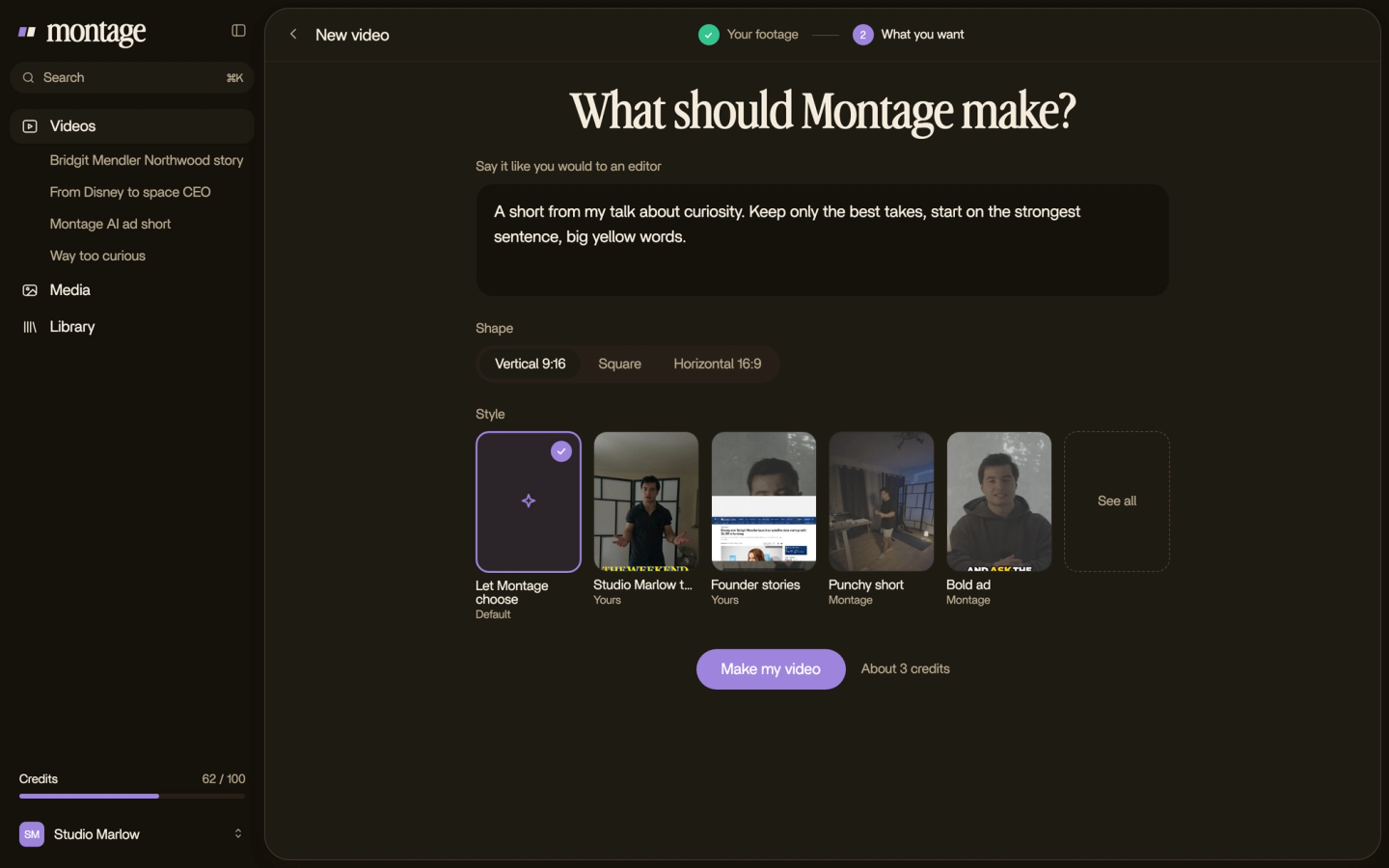
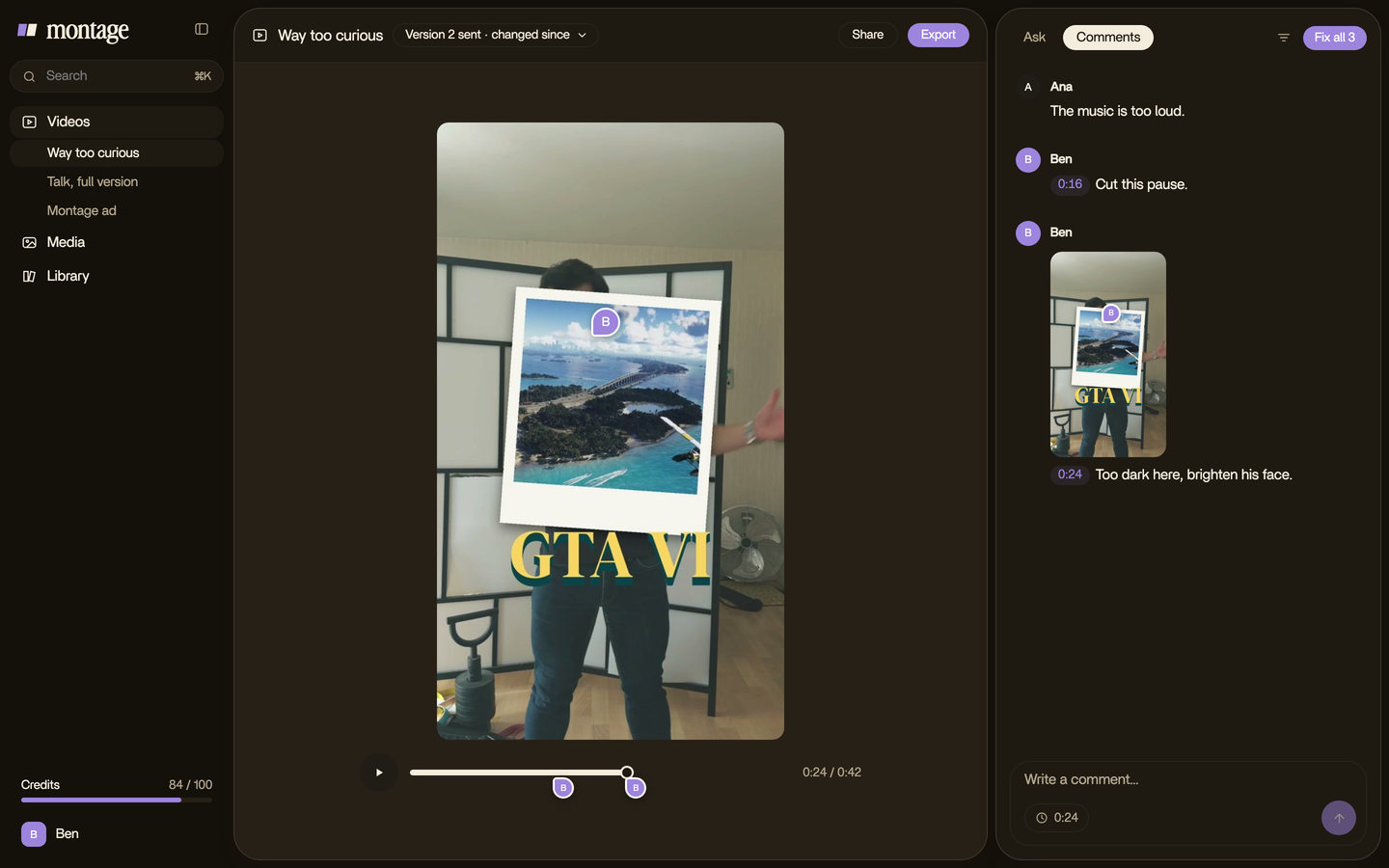
The smash cut stays yours to plan. You can see the result of the jump cuts in the 9-minute film with 216 cuts.
Smash cut vs jump cut: your questions.
What is the difference between a smash cut and a jump cut?
A jump cut stays in the same shot and skips forward in time, so the pauses are gone. A smash cut leaves the scene
suddenly, at an unexpected moment, for a jolt of contrast: a laugh, a scare, a reveal.
What are smash cuts used for?
Surprise. A joke (the Gilligan cut: someone promises one thing, the next shot shows the opposite), a scare (waking from
a nightmare), or a sudden jump in time.
Why do people use jump cuts?
To take out the pauses and the retakes and keep the pace. In a talking-head video, they're normal, and people expect
them.
What is the most common cut in editing?
The plain cut, also called a hard cut: one shot ends, the next begins, nothing in between.
Is a smash cut a kind of jump cut?
Wikipedia says it's « sometimes defined as a subtype of jump cut ». I don't think so: a jump cut stays in the shot, a
smash cut leaves the scene. Different job, different cut.
See it in real videos.
Every jump cut and every B-roll in this guide is in a real video, each one asked for in a sentence. Watch them, and see if you can spot the cuts.
 9:18
 2:07
 0:56
 0:38
That's it for this one. Cut the pauses, and save your smash cut for the moment that deserves it.
See you in the next one.