Will AI replace video editors? The honest answer.
AI is already doing the hands-on part of editing. The decisions are still yours. Let me show you where the line sits, on real videos.
 Ben, founder of Montage · · 7 min read
In this post8 parts
- The short answer
- What everyone says, and what they leave out
- Will AI take over video editing? What it already does
- What gets replaced is the timeline, not the editor
- Who should still learn a timeline editor
- Is there a future in video editing? The numbers
- Will AI replace video editors? Your questions
- See it in real videos
The short answer.
Ladies and gentlemen, let's start with the answer.
Will AI replace video editors? It's replacing the hands-on part already: the cutting, the placing, the grading clip by clip. It isn't replacing the decisions: what to keep, what to show, what the video should feel like. Those stay with a person.
Now, who that person is depends on who you are.
- If you film yourself and never had an editor, the honest answer is good news. AI can now do the editing you'd never have paid for. You make the calls, it does the work.
- If you edit for a living, or want to, the hands-on part of your job is going. The judgement isn't. And a job in film or TV still means Premiere Pro or DaVinci Resolve.
So which tool does this today? There are a few kinds, and I sorted them in the best AI video editors, compared.
AI does the work. You still make the calls.
What everyone says, and what they leave out.
I read the pages that rank for this question. They pretty much agree.
Nigel Camp, a London filmmaker with 15 years of interview films, splits editing into two layers: the repeatable production work, which AI takes, and the interpretive work, which stays human. Unsplice, an editor-training site, quotes a World Economic Forum study: 0% of a video editor's job can be fully automated, 72% can be augmented.
Then there are the predictions. On LinkedIn, Ruben Hassid wrote: « AI will replace 80% of video editors by 2030. » It's a prediction, with no source, and in his own comment he says he's Opus Clip's brand ambassador. Jake Drake, on LinkedIn too, says the opposite: AI won't replace editors, strategy will matter more.
Here's the thing: every one of them argues it from the editor's chair, with studies and predictions. None of them shows a real video edited by AI and points at where the human decision sat. So let me do that.
Will AI take over video editing? What it already does.
So what does AI actually take over? Let me explain, with the real cards from Montage's showcase videos. On the left, what was decided. On the right, what the AI did.
| The video | What the person decided | What the AI did |
|---|---|---|
| Way too curious | « I asked for a grade, no LUT » | « Montage lifted it on its own » |
| From Disney star to space CEO | The NOMAD LUT on takes 4 to 7, « the first three left as they were » | The LUT on each of the four takes |
| From Disney star to space CEO | A face cam as « a macOS window over the James Webb images » | The same window « on every one of the 216 cuts » |
| How to be creative | The notebook shots belong in the video | « Montage turned them the right way up » |
| How to be creative | What I talk about: the book, the notebook, the whiteboard | « It cuts to the right shot » |
Do you see the pattern? The left column is a sentence. The right column is hours on a timeline.
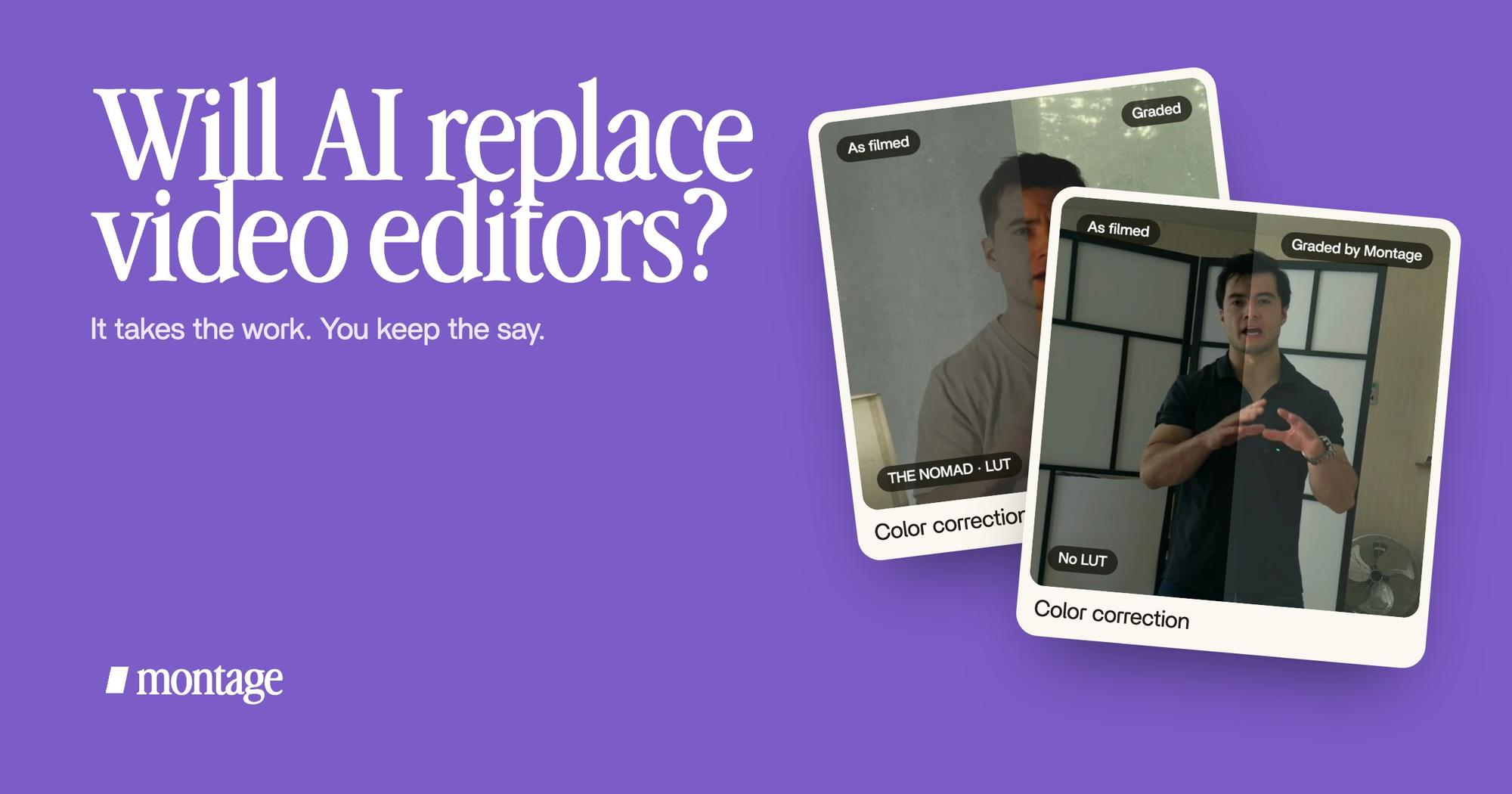
 Color correctionFilmed too dark on an iPhone. I asked for a grade, no LUT: Montage lifted it on its own. Same frame, split.
 Color correctionTakes 4 to 7 were filmed flat: the NOMAD LUT on each, the first three left as they were. Same frame, split.
Take the grade. Way too curious was filmed too dark on an iPhone. One request, and the picture was lifted. In From Disney star to space CEO, four of the seven takes were filmed flat and got the LUT; the other three were left alone. Which takes get a look, and which don't, is a decision. Applying it, shot after shot, is work. More on grading done by asking.
 ComponentsMy face cam is a component: a macOS window over the James Webb images, on every one of the 216 cuts. Click to watch it.
 RotateThe notebook shots were filmed from above, upside down. Montage turned them the right way up.
And the work that's simply gone? A face cam placed on 216 cuts. Notebook shots filmed from above, upside down, turned the right way up. Nobody misses doing that by hand.
The left column is yours. The right column was always the boring part.
What gets replaced is the timeline, not the editor.
I think this is the part people miss.
The hands-on work AI takes over is the work done on a timeline. Cutting clips. Placing them. Keyframing a zoom. Grading one clip, then the next. That strip of clips was never the editing itself. It was where you did the editing by hand.
Editing is the decisions. As I wrote in where a beginner should start: the software changes, the decisions don't.
So what does editing look like without that work? In Montage, you say what you want, watch the result, and comment on the video at a moment or on a spot of the picture. Like with an editor sitting next to you. Then you fix everything at once.
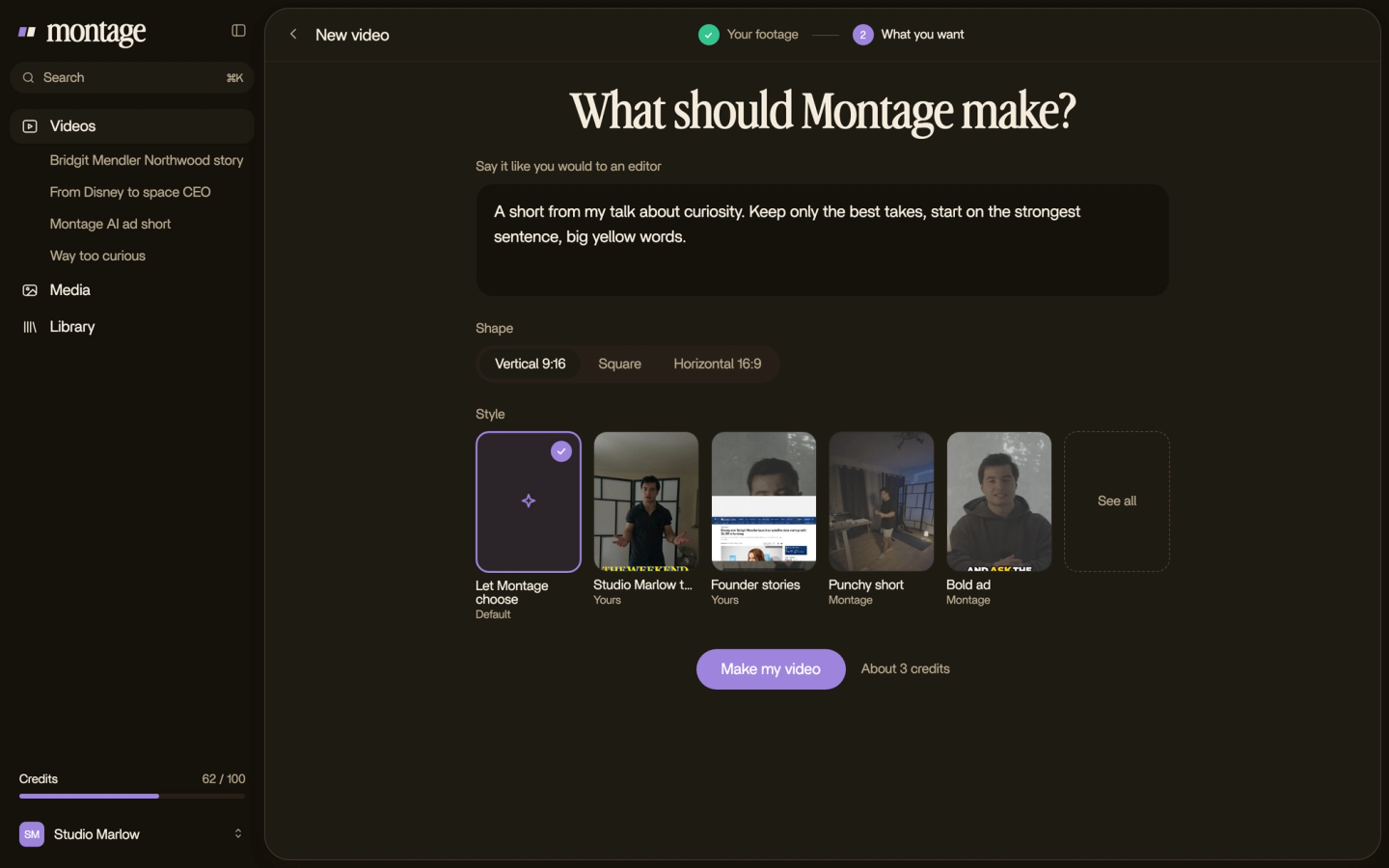
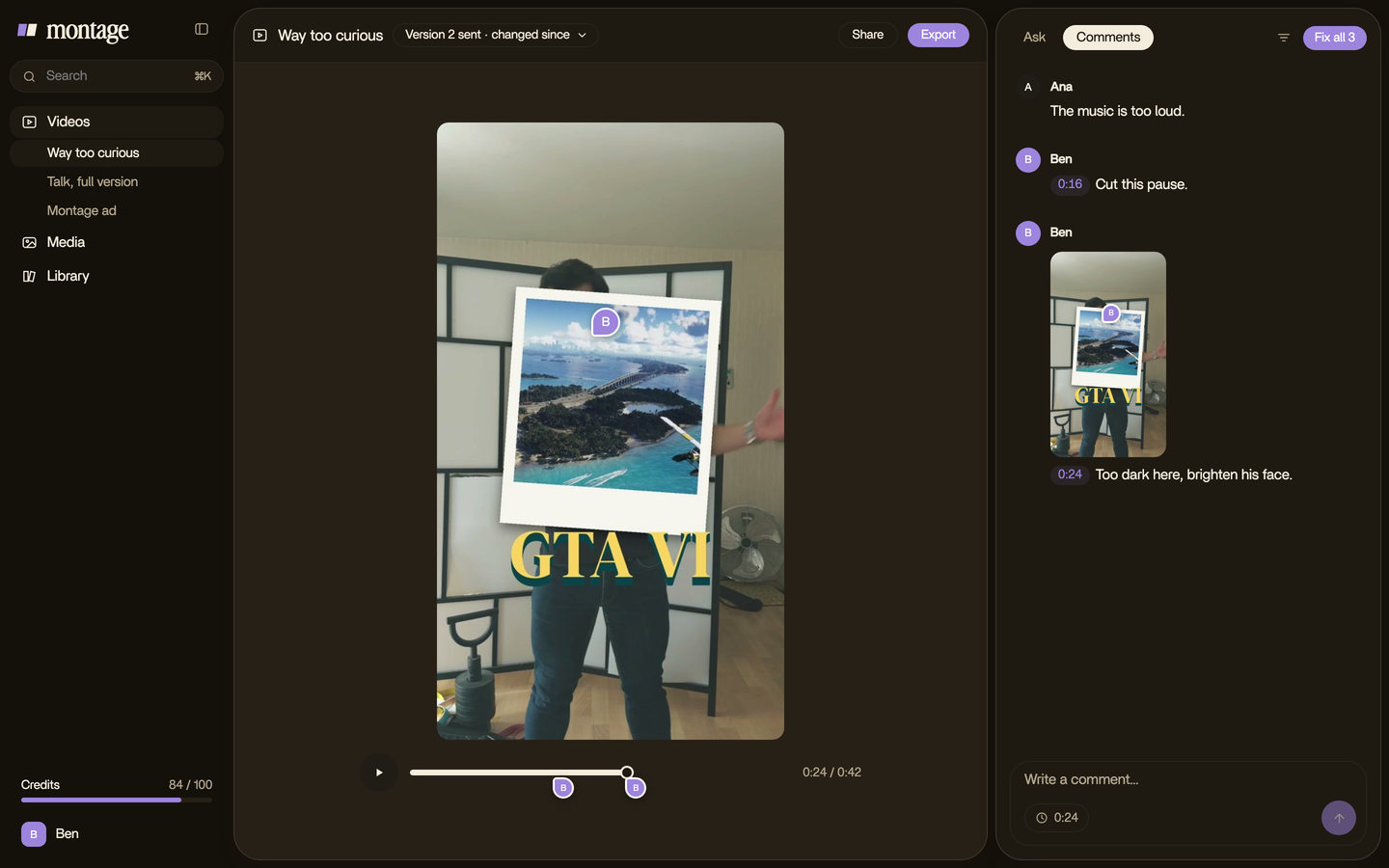
That's what I mean when I say you can edit a video by talking to it. And it's not the only way tools are going. To be fair to the others:
- Premiere Pro adds AI into the timeline. Adobe put a Generative Media tool inside it on September 8, 2026 (Nigel Camp's page, updated September 11, 2026).
- Descript lets you edit from the transcript, and keeps the timeline « if you need it ». More in editing from the transcript.
- ChatCut takes prompts, then lands every edit on a timeline to adjust by hand.
I think the timeline goes. The editor doesn't.
If you want to go deeper on the tools themselves, I wrote about an AI agent that edits for you, an app that edits your videos automatically, and whether ChatGPT can edit a video.
Who should still learn a timeline editor.
Let's be clear: AI editing isn't for everyone yet.
| Describe it to an AI editor | Learn Premiere Pro or DaVinci Resolve | |
|---|---|---|
| Best for | Creators who film themselves, founders, small teams with no editor | Anyone who wants a job in film, TV or agency post |
| What you do | Decide, watch, comment | Decide, then do every step by hand |
| What you learn | What to cut, what to show, what it should feel like | The same, plus the program |
| Not for | Studios that need an industry tool | People who just want a video out this week |
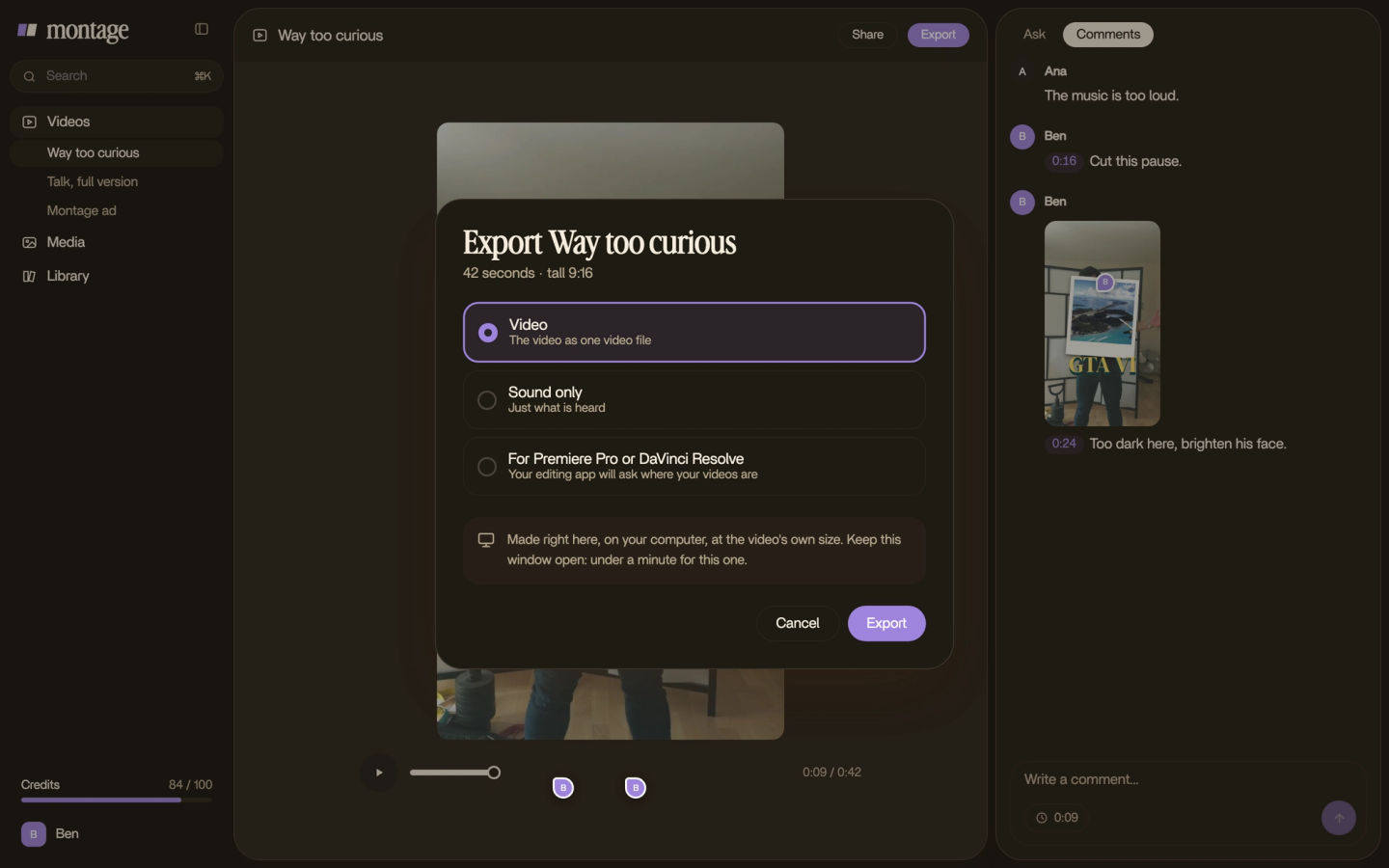
Here's the thing: you don't have to pick one forever. Montage exports the cut for Premiere Pro or DaVinci Resolve, so the AI can do the first pass and you finish it on the timeline you know.
Is there a future in video editing? The numbers.
Okay. What do the numbers say about the job?
- 28,860 film and video editors were employed in the US in 2024 (Bureau of Labor Statistics, via willrobotstakemyjob.com).
- Their median annual wage was $70,980 in 2024 (same source).
- Job openings are expected to rise 3.7% by 2035 (same source).
- The same site puts the automation risk at 41%, « Moderate ».
- The World Economic Forum study quoted by Unsplice: 0% of the job fully automatable, 72% augmentable.
Truth is, those numbers say the same thing as the real videos: the trade isn't disappearing. The hands-on part of it is.
Will AI replace video editors? Your questions.
Will AI replace video editors?
Not the decisions. AI already does the hands-on part (cutting, placing, grading clip by clip), but someone still decides
what to keep, what to show and how it should feel. For creators who never had an editor, AI can now do that work for
them.
Is AI going to take over video editing?
It's taking over the timeline work: cuts, captions, color, the same element placed on hundreds of cuts. It isn't taking
over taste. You still watch the video and say what's wrong.
Is there a future in video editing?
Yes. The Bureau of Labor Statistics counted 28,860 film and video editors in the US in 2024, with openings expected to
rise 3.7% by 2035 (via willrobotstakemyjob.com). The work changes; the role stays.
Is video editing a good career?
In my opinion, yes, if you aim at the judgement: story, pacing, what to leave out. The median US wage was $70,980 in 2024
(BLS, via willrobotstakemyjob.com). The purely mechanical work is the part to stop betting on.
Should I still learn Premiere Pro or DaVinci Resolve?
If you want a job in film, TV or agency post, yes. That's what studios use. If you just want your own videos out, you can
start by describing the edit, and still finish a cut in either one later.
See it in real videos.
Everything in the table above comes from real videos, each one asked for in sentences. The four real videos in the showcase show what went in and what came out.
 9:18
 2:07
 0:56
 0:38
So, will AI replace video editors? It takes the work. You keep the say.
See you in the next one.