Video ads examples:
what the best ones do.
Every list of video ads shows you Nike and Apple. Here they are too, sorted by what a small team can copy. Then one real ad, taken apart piece by piece.
 Ben, founder of Montage · · 11 min read
In this post10 parts
The short answer.
Ladies and gentlemen, let's start with the answer.
The best video ads examples all do the same four things. They earn the first seconds with a hook. They make one promise, not five. They show the product doing its job. And they end on one clear action. That's it. From Nike's split screens to a 15-second Facebook ad, every good one does those four.
Now, here's the thing: almost every ad you'll find on those lists was made by an agency, with a crew and a budget you don't have. So I sorted them by what you can actually copy. Then I took one real ad apart, piece by piece: a 38-second vertical ad with me on camera, edited by asking Montage. If you want to make every version and size of your ad once you've seen them, that's where to go.
Truth is, you can't copy Nike's budget. You can copy Nike's idea.
How I picked these examples.
So how did I choose? Simple. Every famous ad below comes from the lists that rank for this search, as their authors describe them: Zeely, Storykit, Karola Karlson and Aimers. I kept the ones where the idea is clear in one sentence, and I sorted them by type.
Each one gets the same block: what happens, why it works, and what you can copy without a crew.
Video ads examples, sorted by type.
1. The brand story
Nike, « You Can't Stop Us ». Athletes in perfectly aligned split-screen shots, one sport flowing into the next. Storykit calls it « visually stunning, emotionally driven ». Airbnb, « Welcome »: a miniature handmade world that makes travel feel warm, as Zeely describes it. Google, « Year in Search »: each year, the top searches turned into one moving video.
What you can copy: the editing idea. Nike's whole trick is a split screen. What you can't: the athletes and the rights.
2. The product demo
Smart Nora: the ad shows the problem (snoring), then the device gently moving the pillow to stop it. Grammarly: the product fixing your writing in emails and posts, in situations you know. Google Calendar, in Aimers' list: the app's features over real-life moments where you'd need them.
What you can copy: everything. A problem, then your product solving it on screen. You already have both.
3. The one-feature ad
Apple, « Quiet the Noise »: a city turns surreal, and AirPods Pro shut the noise out. One feature, the whole story. Hinge, « Designed to Be Deleted »: the app icon keeps dying, and the brand line explains the whole app in seconds.
What you can copy: pick the one thing your product does best and build the ad on it alone. That's free.
4. The funny one
Old Spice, « The Man Your Man Could Smell Like »: every beat escalates the joke, and the product promise stays simple. Dollar Shave Club: Zeely calls it one of the cleanest value-prop ads ever made, because the offer is obvious fast. Volkswagen, « The Force »: a child dressed as Darth Vader tries to use the Force, until dad starts the car remotely. Slack, « So Yeah, We Tried Slack »: a fictional team of sandwich-makers tries the product.
What you can copy: a joke that comes back to the product. What you can't: the actors, the sets, the stunts.
5. The SaaS explainer
Jira opens on the finished result and tells the story backwards, so you want to see how it got there. GitLab opens on a text hook and ends on one line: « Build software faster. » FreshBooks is animation only, and Aimers' point is that it didn't need a big budget. Notion's 2025 Agents launch shows the agent doing a task, before and after.
What you can copy: pretty much all of it. A text hook, your product on screen, one line to end on.
6. The mistakes
Zeely keeps a few anti-examples too. Jaguar, « Copy Nothing »: great mood, but you remember the atmosphere before the product. Peloton, « The Gift That Gives Back »: the story viewers told about it was stronger than the one intended.
If people remember the mood and not the product, the ad didn't do its job.
What a small team can copy, side by side.
Okay. Let's put them in one table.
| Example | Type | The hook | Copy it without a crew | What you can't copy |
|---|---|---|---|---|
| Nike, « You Can't Stop Us » | Brand story | Split screens that line up | The split-screen idea | The athletes, the rights |
| Smart Nora | Product demo | The problem, then the fix | Problem, then product, on screen | Nothing: you have both |
| Apple, « Quiet the Noise » | One feature | A city turns surreal | One feature as the whole ad | The effects budget |
| Hinge, « Designed to Be Deleted » | One feature | The icon keeps dying | One line that says it all | Nothing |
| Old Spice | Funny | A joke that keeps escalating | A joke that ends on the product | The set, the stunts |
| Volkswagen, « The Force » | Funny | A kid as Darth Vader | A small story with a twist | The car, the cast |
| Jira | SaaS explainer | The result first, then backwards | Open on the outcome | Nothing |
| GitLab | SaaS explainer | A text hook | Words on screen, one closing line | Nothing |
Do you see the pattern? The ideas are copyable. The budgets aren't. And the pieces you can copy are pretty much always the same: a hook, the product on screen, words you can read, one action at the end.
Facebook video ads examples: what the feed rewards.
Now, the Facebook part. Most people searching for Facebook video ads examples are about to run one, so let's be practical.
Karola Karlson, a Facebook marketer, browsed the Facebook Ad Library and found that 80% of the top brands' Facebook ad creatives were videos. Her list of 35 is the most hands-on one out there. Here's what her examples share:
- The first 3 seconds matter most. VSCO opens on a bright color that leads your eye to the words « transformative tools ».
- Words in the video. Keep the copy on screen, so the ad makes sense without sound.
- The product, shown. Monese shows its app in action.
- One action at the end. Monese ends on « download the app ».
- Small tricks. Restream turned its static ads into moving ones. Moo uses an endless loop. The New York Times tells a whole story with text only.
- A mix of both kinds. Short performance ads that ask for an action, and longer brand ads (Airbnb's runs 40 seconds) that don't.
Her takeaway, and I agree with it: many of these could have been made in just a few hours. Expensive doesn't mean better on Facebook.
For Reels and the vertical feed, Aimers adds two things: build a native 9:16 version, and keep the key elements in the safe zone, away from the buttons. If your ad is for Instagram first, I wrote more about video ads for Instagram. For B2B, LinkedIn video ads examples have their own rules.
One real ad, taken apart.
So what does all of this look like inside one ad? Let me show you.
Edit it all with AI is a 38-second vertical ad for Montage. I'm the one on camera, and I edited it by asking Montage. I'm not going to give you a performance number, because I don't have one. What I can show you is every piece, in its real frames.
The hook, the product, the words
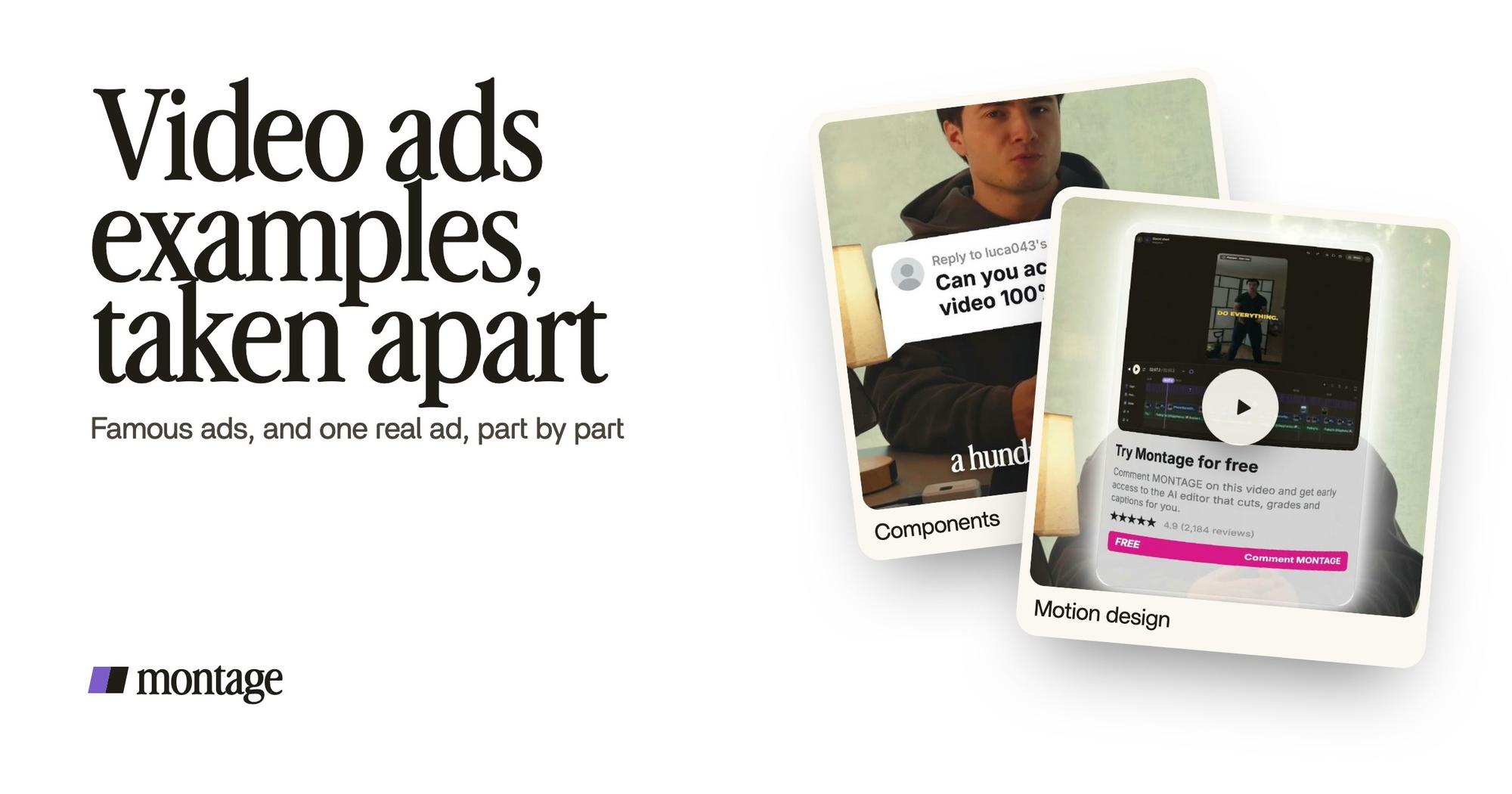
 ComponentsThe hook: a white Instagram reply, made as a component and reused. Click to watch it on its own.
 B-rollThe site drops in on a white stage while I say « go to this app called Montage ».
 CaptionsOne line at a time, white on the take, dark on the white stage.
- The hook: a white Instagram reply. It was made as a component and reused: a hook made once and reused.
- The product on screen: the site drops in on a white stage while I say « go to this app called Montage ». That's the ask, said out loud, with the product right there.
- The words: one line at a time, white on the take, dark on the white stage. Those are the captions for the sound-off feed.
The look and the motion
 Color correctionFilmed flat in HDR, the NOMAD LUT on every shot. Same frame, split.
 Motion designThe product card: frosted at 80 %, a fisheye, a big glow, swiped in from the right. Click to watch it on its own.
 Background effectCut out of my background, my head rises over the top of the frame.
- The look: filmed flat in HDR, with the NOMAD LUT on every shot. Same frame, split, so you see the before and after.
- The product card: frosted at 80%, a fisheye, a big glow, swiped in from the right.
- The pattern break: cut out of my background, my head rises over the top of the frame. A small surprise, the kind that stops a thumb.
Now look back at the table. A hook, the product on screen, words you can read, one action. The same copyable pieces. Just no crew.
The idea is copyable. These are the copyable parts.
The same pieces, inside longer videos
An ad doesn't always run on its own. A sponsor card is an ad inside a video.
 Sponsor cardA component made for the sponsor: frosted glass, the QR code and the code BLG. Click to watch it.
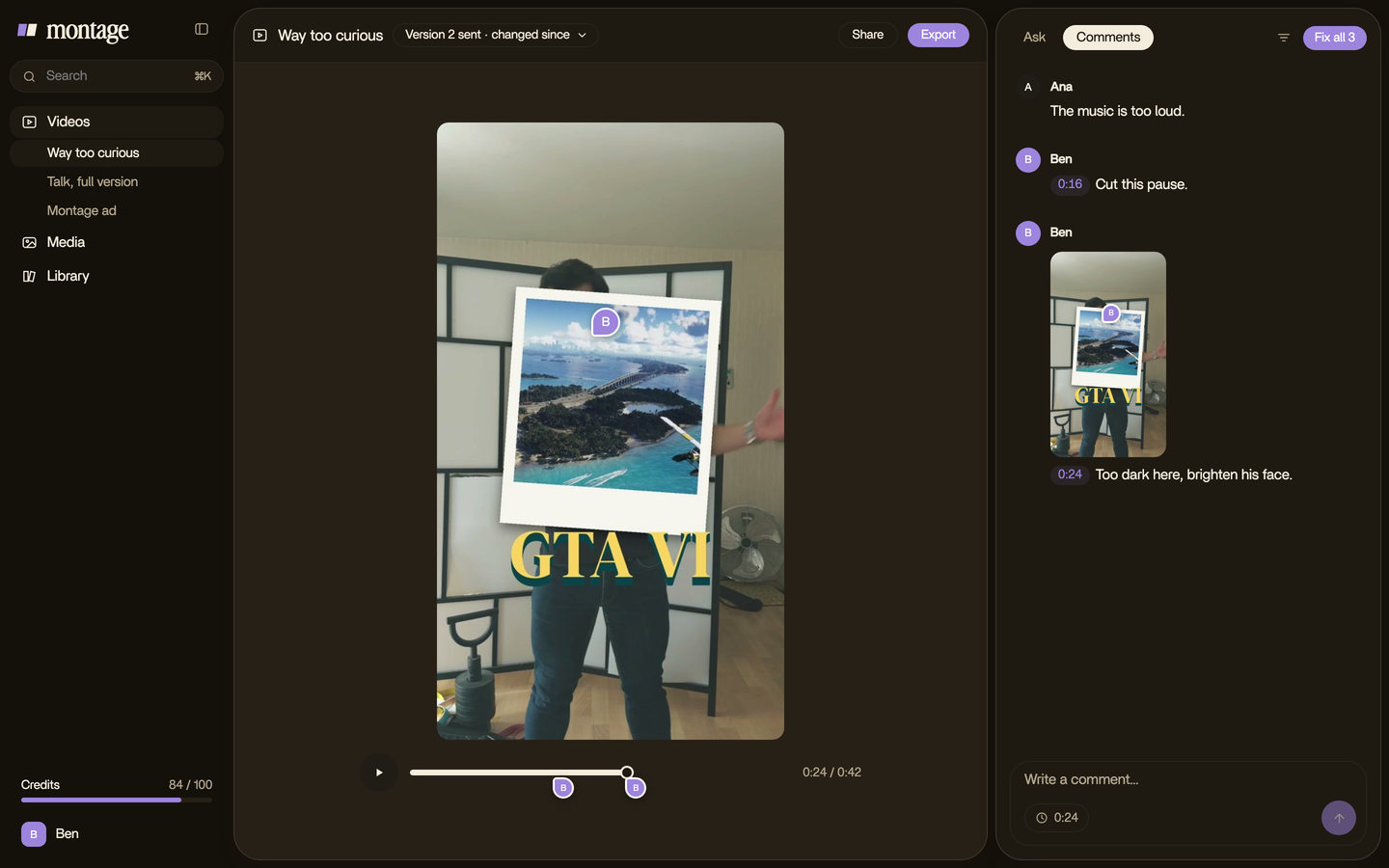
 ComponentsThe Photo drop is a component Montage made from my words: I say GTA VI, it drops in.
In my long-form YouTube film From Disney star to space CEO, the sponsor gets a component made for it: frosted glass, the QR code and the code BLG. In Way too curious, the Photo drop is a component Montage made from my words: I say GTA VI, it drops in.
How to make your own video ad.
Here's how I'd do it. Six steps.
- Pick one type from the list above. A demo, one feature, or a small story. Not all three.
- Write the hook first. What's on screen in the first 3 seconds?
- Film it on your phone. Your face, your product, your screen. If it's software, a product demo from a screen recording works too.
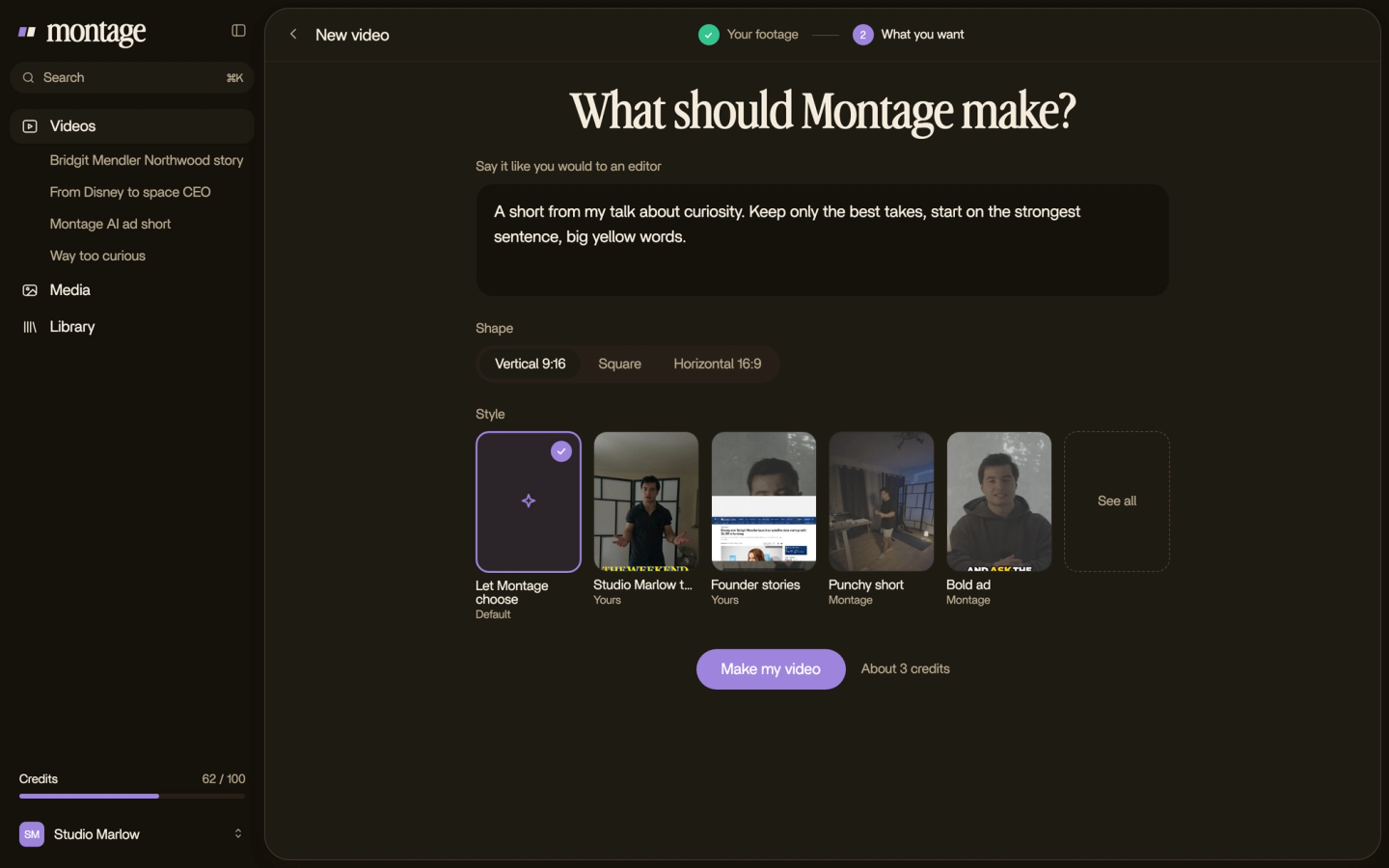
- Say what the ad should be. « A 30-second vertical ad. Open on the reply, cut the pauses, captions one line at a time, show the site when I say its name. »
- Watch it, then comment on what's wrong. Pause, click on the picture, say what to change. Then fix it all at once.
- End on one action. Visit, download, sign up. One.
Want to go further? There's a product launch video for launch day, and how to make a product demo video step by step. If your product needs explaining before it can be sold, start with making an explainer video, see explainer video examples, or go straight to a SaaS explainer video.
Who this is not for.
Let's be clear. If you need a TV spot with actors and a set, hire a production company. And if you want an AI avatar to present your product, look elsewhere: Montage edits your own footage, it doesn't make a presenter for you.
Sure. But if you have a product, a phone and something to say? You have an ad.
Video ads examples: questions.
What is a good example of a video ad?
Nike's « You Can't Stop Us » is the one every list names: one idea, split screens, and an emotional pull. For a small
team, a better model is a product demo like Smart Nora's: the problem, then the product fixing it, on screen.
What are the types of video ads?
The main ones: the brand story, the product demo, the one-feature ad, the funny ad, the social-native feed ad and the
SaaS explainer. Most good ads are one type, not a mix.
What are some popular video ads?
Apple « Don't Blink », Nike « You Can't Stop Us », Old Spice « The Man Your Man Could Smell Like », Volkswagen « The
Force », Dollar Shave Club, and Google « Year in Search ».
How long should a video ad be?
As short as the job allows. Aimers puts it this way: 6 to 15 seconds for a hook or a reminder, 20 to 45 seconds to show
a problem and a product moment, longer for demos and customer stories. The first four of Karola Karlson's Facebook
examples ran about 15 seconds or less.
Can I make a video ad without a crew?
Yes. Karola Karlson says many of the ads on her list could have been made in just a few hours. My own ad above is me on camera,
edited by asking Montage.
What makes a video ad work?
Google's ABCD, as Aimers sums it up: Attention, Branding, Connection, Direction. In plain words: a hook, your brand early,
a reason to care, and one action.
See the ad, and the others.
Everything in this article is in real videos. Watch the ad and the other videos in the showcase, each one with what went in and how it was made.
 9:18
 2:07
 0:56
 0:38
That's it for this one. Now go make your ad.
See you in the next one.